
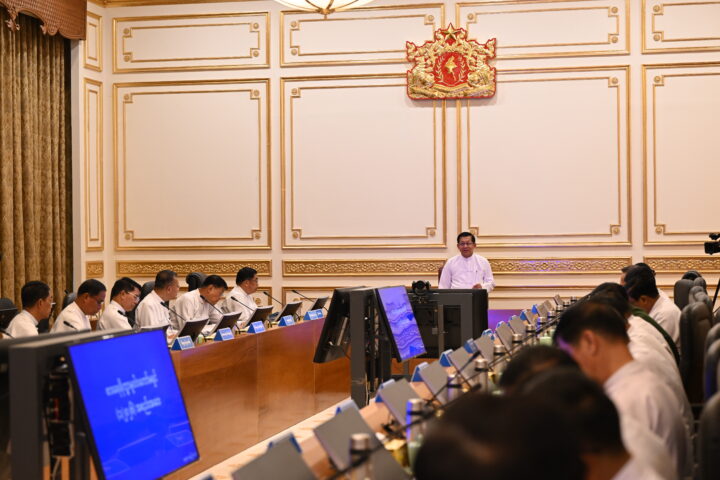
A policy must be implemented to promote the cultivation of fruits and crops suitable for and can thrive in each state and region, in order to achieve domestic self-sufficiency, said President of the Republic of the Union of Myanmar U Min Aung Hlaing, who chairs the Food Policy Commission, at the meeting hall of the President’s Office yesterday morning.
In his speech, the President underscored that food security is a key national policy. Food refers to all necessary food supplies, which should be sufficiently produced within the country itself at the respective state and region levels in order to achieve self-sufficiency.
He explained that there are over 33 million acres of cultivated land in Myanmar. Agricultural activities are being carried out on approximately 15 million acres for paddy, 1.9 million acres for maize, 2.7 million acres for pulses and beans, and four million acres for sesame.
He unveiled his vision that Myanmar must become a major supplier and exporter of food to the international community.
He outlined that as oil crops are cultivated in the country, a policy must be formulated to produce sufficient cooking oil at home. Moreover, efforts must be made to increase cultivation and production of wheat.
In the agriculture sector, the President continued that a policy has been adopted to meet the target cultivation per acre. Rather than expanding cultivated acreage, it is necessary to make efficient use of land and increase productivity. In efforts to ensure food security, it is essential to strive to meet the target of per-acre yield, and to enhance cropping intensity and improve multiple cropping systems.
He stressed the need to formulate and implement policies to convert croplands into irrigated farmland through river water pumping projects. Efforts should be made step by step to increase cropping intensity to as high as 300 per cent in areas where sufficient irrigation water is available.
He noted that it is also necessary to work towards the domestic production of chemical fertilizers, and to systematically manage the proper use of chemical and organic fertilizers. In particular, in remote and difficult-to-access border areas, efforts should be made to enable the local production and use of organic fertilizers. In order to further develop agricultural activities, the State will provide for the issuance of additional agricultural loans to farmers.
The President stated that as animal feeds can be produced from agricultural products, it is necessary to effectively utilize them in livestock breeding activities.
He gave guidance that it is necessary to implement modern agricultural systems in sectors where it is feasible. Likewise, efforts should also be made to develop mechanized farming systems.
He emphasized that it is necessary to continuously conduct research, study, and systematic efforts to further increase the production of rice, pulses, and other food products as well as fishery products.
Commission Secretary Union Minister for Agriculture, Livestock and Irrigation U Min Naung reported on the formation of the region and state level and the Nay Pyi Taw Council food security and agriculture and livestock sector promotion implementation committees.
Commission members discussed the plans to expand the livestock zones, feedstuff production and distribution, efforts to meet the target production of oil crops, supply of water to agriculture and livestock farms, systematic arrangements to prevent loss and damage to agriculture and livestock farms in disasters, storage of reserved deeds and animal vaccines, implementation of the mechanized farming and integrated farms, sufficient production of quality seeds, export of agriculture and livestock products, prioritized plans of private sector, and collaborative efforts of scholars to receive internationally recognized certificates.
Vice-President Nan Ni Ni Aye and Union ministers reported on the formation of the agricultural product management body, supervision for efficient utilization of agricultural lands under the laws in regions and states, and control of water volume in rivers and creeks and their quality under the law.
In conclusion, the President pointed out that it is necessary to protect the interests of farmers. Just as the State considers and plans for the welfare of farmers, farmers themselves are also required to fully cultivate their sown acreage and to work towards increasing productivity and improving yields.
Also present at the meeting were Vice-President U Nyo Saw, chief ministers of regions and states, senior Tatmadaw officers from the Office of the Commander-in-Chief, deputy ministers, chairs from UMFCCI, Myanmar Rice Federation, Myanmar Livestock Federation and Myanmar Fisheries Federation.
MNA/TTA
#TheGlobalNewLightOfMyanmar