
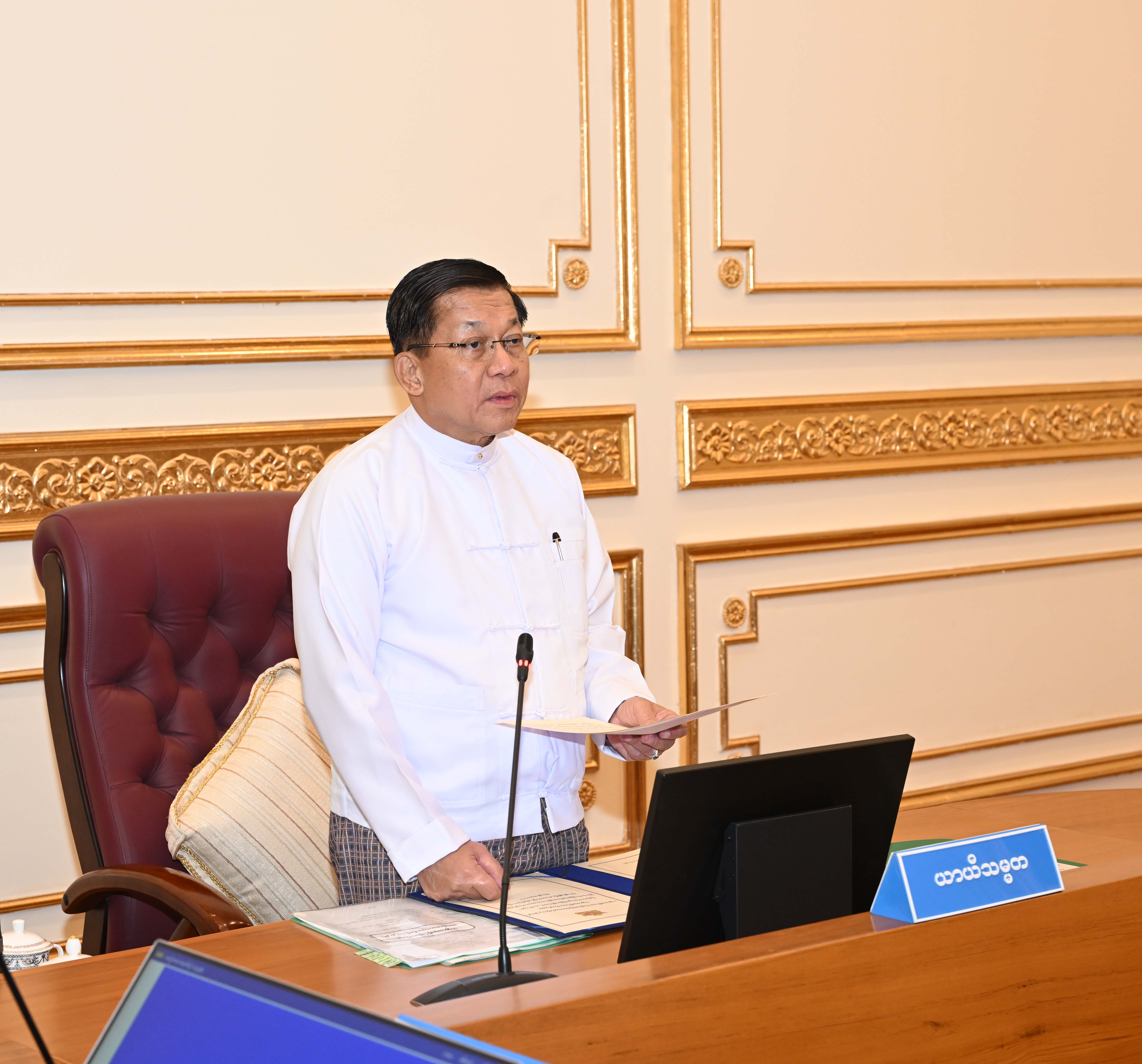
Senior General Min Aung Hlaing underlined that the incoming government must designate and allocate priority expenditures by sector so that ongoing tasks can continue to be implemented without interruption and with sustained momentum.
Chairman of the Financial Commission, Acting President of the Republic of the Union of Myanmar and State Security and Peace Commission Chairman Senior General Min Aung Hlaing said so at the financial commission meeting 1/2026 at the office of the National Defence and Security Council in Nay Pyi Taw yesterday afternoon.
In his speech, the Senior General said that the meeting aimed to discuss and approve the estimated Union budget for the 2026-2027 financial year and the Union Budget Bill concerning the Union’s revenues and expenditures.
In the 2026-2027 financial year, he underlined that the domestic gross product and services value (GDP) of the entire nation is projected to reach K195,032 billion, with an expected economic growth rate of 3.4 per cent.
He stated that after the elections, State responsibilities will be handed over to the government selected and assigned by the Hluttaw meetings. As the current government has already laid the groundwork through constructive measures and achievements, the incoming government must designate and allocate priority expenditures by sector so that ongoing tasks can continue to be implemented without interruption and with sustained momentum.
He highlighted that expenditures will be allocated according to needs for the country’s priority sectors, including: the agriculture and livestock sector, the development of small, micro, and medium-sized enterprises to boost the national economy and reduce reliance on imported goods, education and health sector spending to develop human resources, mandatory expenditures in other sectors, and expenditures required for the maintenance, new construction, and reconstruction of state-owned basic infrastructure damaged by natural disasters or other hazards. These allocations of the budget must be carefully assessed and provided according to actual requirements.
The Senior General stressed that ongoing projects must be completed on time, ensuring that project completion and financial expenditure are properly coordinated, the quality is fully met, and state funds are strictly managed to prevent any waste or loss.
In the 2026-2027 financial year budget estimates, he underscored that it is important to carefully review and allocate only the amounts that can realistically be completed within the financial year for projects that need to be implemented in accordance with the state’s policies, objectives, and procedures.
Commission Vice-Chairman and SSPC Member Prime Minister U Nyo Saw reported that the 2026-2027 financial year’s estimated budgets have been scrutinized at different levels. Allocations for revenue, expenditures, regular expenses, capital expenditures, and debt-related expenditures have also been thoroughly examined. Provisions have been made for expenses arising from unforeseen events and natural disasters, as well as for allowances for government staff and for implementing technological development initiatives.
Commission Secretary Union Minister Dr Kan Zaw presented matters concerning the 2026-2027 Union Budget, the 2026-2027 Union Budget Bill, and the 2026 Union Taxation Bill.
Union Attorney-General and Union Minister for Legal Affairs Dr Thida Oo and Union Auditor-General Dr Khin Naing Oo discussed the 2026-27 FY Union Budget and the 2026-2027 Union Budget Bill, the budgets of the region and state governments, and plans.
In response, the Senior General urged the region and state governments to emphasize development of the State economy and systematically spend the allocated funds.
In the concluding speech, the Senior General pointed out that a strong and resilient economy requires a good and high-quality education system. The development of a country directly depends on the educational quality of its citizens. Hence, it is necessary to enhance the education sector for the betterment of the State’s future.
National unity is extremely important for the peace and stability of the country and for the rule of law. Therefore, all ethnic people need to uphold awareness and mindfulness, firmly stand on the NCA (Nationwide Ceasefire Agreement) path, and work together to achieve a durable peace.
To improve the social and economic lives of rural communities, priority is being given to essential infrastructure such as roads and bridges, irrigation for farming, and access to electricity. With better transport networks, rural residents’ products can be delivered promptly, increasing household income and helping to reduce poverty.
Union ministries and regional/state governments are urged to work together in a coordinated manner within their respective sectors to promote the nation’s future economic development and to systematically lay out a successful development path for the incoming government.
Also, present at the meeting were Union ministers, the Nay Pyi Taw Council Chairman and deputy ministers together with chief ministers of regions and states through videoconferencing.
MNA/TTA
#TheGlobalNewLightOfMyanmar