
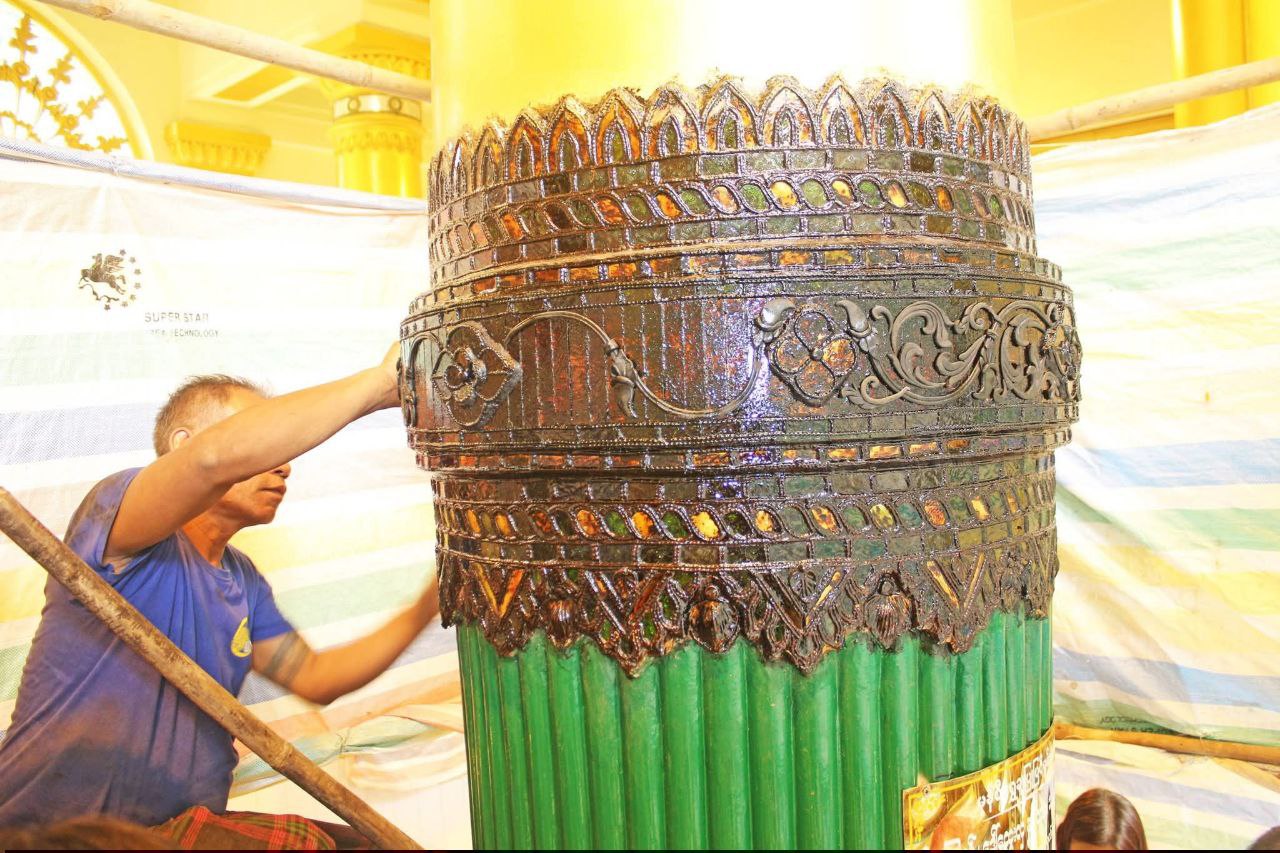
According to the Department of Archaeology and National Museum under the Ministry of Religious Affairs and Culture, efforts are underway to nominate Myanmar’s traditional glass mosaic embedded in gilding craftsmanship as an Intangible Cultural Heritage of Humanity by UNESCO.
At present, documentation and inventory-taking have begun in order to submit the traditional art of glass mosaic work, used in the embellishment of pagoda halls, Pyatthat (tiered-roof structures), rest houses and various utilitarian objects, as an item of Intangible Cultural Heritage under UNESCO.
“We are currently carrying out preliminary work at the national level. We have started compiling records of the successive stages involved in the glass mosaic gilding of pagoda halls, Pyatthat and rest houses. Fieldwork has already been conducted at the Shwedagon Pagoda,” said an official from the Department of Archaeology and National Museum.
It is also intended to commence a national-level inventory of glass mosaic craftsmanship in Mandalay in the near future. The documentation process will include the various stages of the craft and is aimed at identifying and safeguarding this valuable heritage of Myanmar traditional handicraft artistry.
In addition, Myanmar is striving to have its traditional custom of applying Thanaka and its practice of consuming pickled tea (Laphet) inscribed as Representative Intangible Cultural Heritage of Humanity. The traditional glass mosaic gilding craft has likewise been designated as a candidate for nomination.
At the 19th session of the Intergovernmental Committee for the Safeguarding of the Intangible Cultural Heritage, held in Paraguay in 2024, Myanmar’s traditional New Year Ata Thingyan Festival was officially inscribed on the Representative List of the Intangible Cultural Heritage of Humanity. According to the Ministry of Religious Affairs and Culture, Myanmar has so far designated more than 2,200 elements at the national level as Representative Intangible Cultural Heritage.
ASH/KNN
#TheGlobalNewLightOfMyanmar