
I Say What I See: Union Day and My Dad – A Personal Remembrance
By @Editor
Unity in Words, Unity in Action
To begin in my own way, I find it necessary to return to the very meanings of the words “Union” and “Day” themselves. According to global references such as the Oxford and Webster’s dictionaries, a union is defined as the act of joining, or the state of being joined together as one, while a day signifies not merely a unit of time, but a moment set apart for recognition, remembrance, or significance. When viewed together, Union Day is more than a date on the calendar; it is a reminder of collective commitment and shared responsibility.
From a local perspective, English-Myanmar dictionaries render union as ပေါင်းစည်းခြင်း or ညီညွတ်မှု, words that go beyond structure and speak of harmony, mutual respect, and coexistence. Day, meanwhile, is understood as a marked time of meaning, often associated with memory and reflection. These interpretations resonate deeply with our nation and with the many ethnic peoples who have lived on this land through sunshine and rain, through calm seasons and turbulent years.
In this sense, Union Day is not owned by history alone. It belongs equally to those who came before us and to those who continue to live, work, and endure together, bound by geography, experience, and hope.
My memory drifts back to my younger years with my siblings — three of us: my elder sister, my younger brother (who, sadly, has passed away), and me. Our father often took us to the Kyaikkasan Grounds, once the grand venue for the nation’s significant celebrations, including Union Day.
We were always delighted to go, enjoying fun fairs, tasting traditional Burmese and ethnic foods, exploring exhibition booths presented by ethnic nationalities and ministries, and riding the merry-go-round or the makeshift toy train. These moments remain vivid in my memory, unforgettable even now.
We also never forgot the podium and stage at the centre of Kyaikkasan Grounds, where delegates from the then states and divisions – Shan, Mon, Rakhine, Kayah, Kayin, Chin, Magway, Kachin, Taninthayi, and Ayeyawady, among others – spoke of unity and solidarity among all ethnic peoples living peacefully in our nation for generations. These gatherings, these words, and my father’s presence there left a lasting impression on me. This, I realize now, was my real-life remembrance of my late father.
Looking back, those childhood visits with my father were more than just days of joy and amusement; they were lessons in the spirit of our nation. Union Day was not merely a public holiday marked by flags and speeches; it was a living demonstration of unity, of people from diverse backgrounds coming together under one roof to celebrate shared heritage and common purpose. Today, as I witness Union Day commemorations across the country, I see the echoes of those past moments – the stalls, the exhibitions, the calls for solidarity among ethnic peoples – and I am reminded that the essence of this day lies not only in ceremony, but in the everyday commitment of our citizens to live together with mutual respect, harmony, and responsibility.
The memory of my father standing among the crowds, guiding us through the celebrations, quietly instilled in me an understanding of what it means to be part of a Union. It is in these personal recollections, interwoven with the collective observances of our nation, that the significance of Union Day comes alive. It is at once historical and present, public and deeply personal – a reminder of the enduring threads that bind us, and of the work still required to nurture them.
As Union Day unfolds each year, I cannot help but see it through the lens of my father’s presence and guidance. The lessons he imparted – of respect, unity, and care for our fellow citizens — remain with me, quietly shaping how I perceive our nation and its people. Union Day, therefore, is not only a day of public commemoration; it is a call to action, a reminder that the strength of our Union depends on the small, persistent efforts of each individual to honour our shared history, uphold justice, and foster harmony among all ethnic peoples. In remembering my father, I also remember the enduring responsibility of every citizen: to walk hand in hand with others, to nurture understanding, and to help build a Union that is strong, peaceful, and lasting, just as he quietly taught me all those years ago.
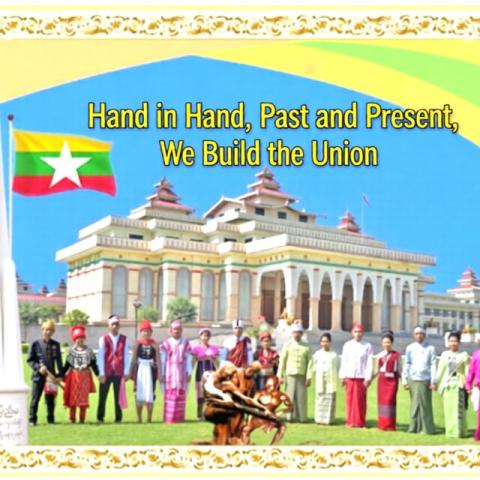
Hand in Hand, Past and Present, We Build the Union
#TheGlobalNewLightOfMyanmar