





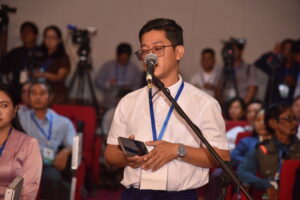
Daw Myintzu Zaw Toe of the Popular News journal asked that she wanted to know how the government and Tatmadaw will handle the telecom fraud and online gambling activities and illegal foreign entrants in Minletpan.
Maj-Gen Zaw Min Tun replied that the Minletpan case has already become known to the media, and that the case is a manoeuvre by the KNU to show that it is not connected to online fraud after having previously committed online fraud activities. He said that this was done to divert attention from the Government’s ongoing efforts to decisively and comprehensively crack down on online fraud and online gambling operations. To that end, he said, KNU staged a show of seizing the KKO group — an organization in which the KNU itself had been involved (adding that he had previously explained how and in what ways the KKO group and certain elements of KNU had been connected in some areas) – to conceal from the public the depth of their own involvement. He added that these points were also presented in their PowerPoint materials. He further said that, through the embassy of a foreign country, they had received information that citizens of that country had died in the Minletpan case. With regard to this matter, he said that investigations are currently underway and that, once the investigations are completed, further actions will be taken accordingly.
He continued that, as he had previously stated, online fraud cases would be eradicated, and that strong action would be taken against online fraud incidents wherever they occur in Myanmar. In connection with the question, he also wished to address certain situations arising along the Myanmar-Thailand border. He said that they are carrying out security measures and the demolition of structures in border areas, and that the objectives of these operations had already been explained. He said that, in an attempt to disrupt these efforts, the KNU has been instigating fighting in those areas, including clashes with Tatmadaw members. He added that there have also been claims from Thailand that shells fired by the Myanmar Tatmadaw have landed inside Thai territory, and that he did not entirely deny this. He stressed that Myanmar and Thailand are neighbouring countries, and that mechanisms for border affairs between the two countries have already been established down to the basic level, with coordination being carried out through township-level bilateral border committees, district-level bodies, and regional-level mechanisms. However, he emphasized that some of the incidents were not the result of fire from their side. He alleged that the KNU was deliberately creating problems between Myanmar and Thailand, including firing rounds into Thailand while staging the appearance of fighting. Concerning this, he said that at the Minletpan location he was about to show, it could be seen that KNU elements were deliberately firing 40mm grenades into Thailand. He said he would present the video footage, adding that the firing was directed toward Thailand, that no fighting was taking place at the time, and that this served as evidence. The video shows KNU elements firing across the Thaungyin (Moei) River into Thailand without any engagement taking place. He claimed that such actions were intended to create misunderstandings and provoke problems between the two countries. He added that only by acting in this way could the KNU and KNU-linked terrorist groups continue to exist, as instability and problems along the border are what sustain their presence and operations. He concluded by saying that Myanmar and Thailand are neighbouring countries that have maintained relations for many decades, and that both sides would counter such attempts to sow misunderstanding through friendship and cooperation, and would continue to work together bilaterally.
Deputy Chief Editor U Myo Min Latt of Amimyay Thitsa Thadinsone news journal asked about the eradication strategy. He said he would like to know about certain areas of cooperation between the Government and organizations currently operating in Kayin State, such as NCA signatory groups like the DKBA, organizations such as the KNU/KNLA-PC, and groups like the BGF that are currently under the authority of the State defence.
Maj-Gen Zaw Min Tun said that this point had already been included among the terms he mentioned earlier. He wished to state that, within online fraud activities, not only some EAO groups but also certain armed groups are involved. However, rather than saying that organizations themselves are involved, it should be understood that the activities are carried out either by individual members within those organizations or by small groups that follow those individuals. What he wanted to emphasize was that bad blood must be removed. Just as there are good people in every organization, there are also bad ones, and not all organizations are bad. At present, among those operating in the Shwe Kokko area, some BGF members are involved in cooperation, while some BGF members are not involved at all. Therefore, clear distinctions must be made. He also said that EAO organizations should not look at the face of the government, but instead look at the face of the State and the people.
Chief Editor Daw Khaing Sabei Oo of Hein Thitsa Thadinsone Journal said it was known that Myanmar is currently accepting individuals who entered from other countries and were involved in online fraud activities, including those who committed or participated in such crimes, and is bearing the full costs of feeding, accommodating, and caring for them before repatriating them to their countries of origin. She questioned whether, when Myanmar citizens have been involved in such activities in other countries or have been exploited in illegal activities or other unlawful work, those countries have similarly cared for them and repatriated them to Myanmar in this manner, and how many such cases there have been.
Maj-Gen Zaw Min Tun replied that, internationally, these matters constitute transnational crimes and are carried out collectively by criminals and fugitives who have fled from other countries through illicit means. While he could not provide an exact figure in response to the journalist’s question, he noted that every country has its own standards at the international level, including established humanitarian standards. Therefore, if a Myanmar national commits an offence in another country, that country handles the case in accordance with its own laws. Providing food and accommodation and conducting screening before repatriation are procedures practised by all countries. He added that such measures are being carried out and that repatriation to Myanmar is also taking place.
Chief Executive Officer U Min Htet Paing of Thadin Naga Thadinsone Journal said it has been observed that as online fraud and gambling have become more widespread in Myanmar, Myanmar citizens, as well as citizens of other countries, are suffering from related criminal activities. While it is understood that the current period is one of cracking down on and eradicating such crimes, he wished to know the situation regarding how quickly citizens from other countries, as well as Myanmar citizens, who have unwillingly fallen into online fraud operations, will be rescued, protected, and provided with assistance.
Maj-Gen Zaw Min Tun explained that there are some complexities in online fraud cases. The complicated aspect is that, in some instances, individuals did not commit the crime themselves but had their phone numbers, identification numbers, or images misused. There are people in Myanmar who have suffered such harm. However, in other cases, it is not a matter of victimization but of collaboration. As stated by the Deputy Minister of Home Affairs, while it is true that some individuals were victims, others were not victims and carried out the acts themselves. He acknowledged that such cases exist in Myanmar and that there are also foreign nationals involved. He said the number of those arrested so far is relatively small. As the Deputy Minister of Home Affairs noted, although some individuals were arrested and deported, certain people later willingly returned. Such individuals must be clearly identified and distinguished. Those who are guilty will be dealt with severely. He said Myanmar’s position has already been made clear: online fraud is not the deception of a single person, but the deception of large numbers of people, and is therefore regarded as a serious crime committed against the public. Accordingly, those who require protection will be protected, while those who must face firm legal action will be dealt with decisively.
Reporter U Win Zaw of Ahmantaya Thadinsone Journal said that he welcomed the formation and operation of the Supervisory Committee for Combatting Online Fraud and Online Gambling, and expressed confidence that online fraud and online gambling would be eliminated as soon as possible. He noted that many people are engaging in fraudulent sales of online gambling schemes, such as car, motorcycle, land plot, and house lotteries, advertised online as prize draws that would pay out if the three-digit Thai lottery numbers match. He wished to know whether action is being taken and arrests are being made against such online lottery operations.
Police Brig-Gen Kyaw Lin replied that online gambling activities can be found operating on the internet in various forms and through a wide range of methods and games. Those who fraudulently sell illegal Thai lottery schemes and prize draws involving cars, land, houses, and similar items are being identified through technical means and prosecuted under the Gambling Law. He added that as of December 2025, action has been taken in 107 online gambling cases.
Chief Reporter Ko Thuta Kyaw of the NP News news agency said that online scams are being eradicated along the border areas, but there have been reports that some of the perpetrators have crossed into the country. There are also reports claiming that corrupt activity is involved in the actions taken against them. He wished to have a clear response regarding this matter.
Maj-Gen Zaw Min Tun said that online gambling involves two layers of complexity: first, the technical aspects, and second, the individuals carrying out the activities. Regarding the technical aspects, even if online gambling operations are suppressed locally, certain technical elements may remain intact, and it is impossible to completely remove data that exists “in the cloud” or on the internet. Such information cannot be fully known even by journalists or the authorities, making it difficult to eradicate. The second layer involves individuals committing online gambling offences. He noted that those engaged in such activities are rarely upright or law-abiding people; internationally, most offenders are fugitives or criminals who have fled other countries, and they often have networks or groups supporting them from behind the scenes. He continued that, for this reason, they are tracking certain cases and coordinating efforts in collaboration with all relevant parties. Those who are suppressed at the borders may still enter Myanmar, and it cannot be said that this is impossible, nor do they deny it. Journalists have already observed how many individuals have left the country, and some can also enter Myanmar. When they enter, the authorities will take decisive action to suppress them. He emphasized that when individuals enter Myanmar, the primary responsibility lies with the local population: the people themselves should report relevant information without pretending not to see or hear anything. If they ignore what they see or hear, it is as if the suppression has already begun. Secondly, there should be no place for offenders to hide – they will only be able to hide among the local population. To prevent hiding, he urged that if any suspicious individuals or situations are observed, the community should work together with law enforcement authorities to take coordinated action.
Senior Reporter U Zeyar Nyein of Myanmar Transparency News Agency said that in recent days, China issued warrants for the arrest of four major gangs from China and around 100 suspected individuals. Based on this, it appears that northern groups such as the MNDAA and TNLA have also been accepting and protecting individuals involved in online scams in exchange for fees. He added that in the Myawady Township area, Tatmadaw is currently carrying out operations to eradicate such activities. In this situation, some armed groups engaged in clashes with Tatmadaw are reportedly taking fees from online scam perpetrators to provide protection and help them evade capture. He wished to know how the responsible authorities and Tatmadaw plan to handle and resolve these matters.
Maj-Gen Zaw Min Tun clarified that some reports have been received, but certain pieces of information cannot yet be verified. Reports are indicating that, even within the Laukkai border area, small groups are continuing online scam operations, though not on a large scale as before. These reports have not been confirmed because there are no dedicated news-gathering organizations in that area, and the information comes indirectly through news channels. However, the sources are considered reasonably reliable. Therefore, they are also cooperating with the neighbouring country, China, and will continue efforts to strengthen the reliability of this information. Based on these ongoing efforts, there are EAO-controlled areas in the border regions and some territories of armed groups further inland, where small-scale operations are still taking place. Arrests have already been made in and around Namsang Township in southern Shan State. According to coordinated intelligence exchanged between the two countries, these activities are ongoing. He emphasized that Myanmar and China will continue working together to identify sources in these areas and suppress online scam activities.
U Zeyar Nyein asked that if the information from these sources is accurate, and if it is true that certain individuals are being sheltered or rescued, he wishes to know how authorities plan to take action in response.
Maj-Gen Zaw Min Tun replied that they have been engaging in discussions with certain organizations. These discussions are aimed at achieving a ceasefire and promoting peace. Regarding the actions of these organizations, they will first issue warnings, and if these are not heeded, the State will take appropriate action.
Senior Reporter U Aung Kyaw Oo of Special Hittaing news agency said that he is pleased with the efforts of the government in eradicating online scams in the border areas. However, he noted that some operations are still accessing phones online through linked systems. Some games, similar to “buffalo games”, reportedly lose around K10 million per day in a very short period. He also observed that certain artists are being used to advertise these activities. He wished to know how these matters are being managed.
Police Brig-Gen Kyaw Lin replied that with the advancement of technology, crimes committed using technology have become more varied and widespread. Regarding online gambling and slot games such as “buffalo games”, authorities have been monitoring and taking action against related social media accounts, including Facebook and Telegram accounts. From 2023 to 2025, over 2,000 Facebook, Telegram, and other social media accounts suspected of being linked to online games were identified and acted upon. In connection with these, more than 2,300 SIM cards were blocked, and 456 linked phone numbers were also disabled. Additionally, over 1,900 Pay accounts used for deposits and withdrawals related to online gambling were blocked. He noted that some advertisements involved actors promoting these activities. In one case in 2025, an actor who advertised on the Miles Ceno Facebook Page was identified, arrested, and prosecuted according to the law. He stated that Myanmar’s police are actively monitoring and investigating online gambling activities using technical methods, and can block accounts, Pay accounts, and social media accounts. SIM cards are also being disabled, and links are continuously monitored, with associated phone numbers being blocked as well.
Chief Editor Naung Taw Lay of Myanmar National Post News Agency said he wished to know whether a case has been filed against Saw Kwe Htoo Win, the leader of the KNU armed group, and his associates, who were primarily responsible for conducting online scam operations. If no case has been filed yet, he wanted to know whether there are plans to open one.
Police Chief Police Lt-Gen Win Zaw Moe said that the KNU was previously considered an unlawful organization. After signing the nationwide ceasefire agreement (NCA), the KNU was removed from the list of unlawful organizations. However, following the political developments in 2021, the KNU has engaged in terrorist acts, including attacks on government offices, destruction of roads and bridges, and disruption of the Asian Highway. At the time of these incidents, the State government could not remain passive toward the KNU. Therefore, on 28 August 2025, the KNU was once again officially declared both a terrorist organization and an unlawful organization. He said that the current situation regarding online scams and online gambling in the border areas, and the KNU’s position on these activities, had already been explained earlier, so it should already be understood. Currently, cases have been filed against the KNU, including leader Pado Saw Kwe Htoo Win, members of the central committee, and their subordinate members, under the Anti-Terrorism Law and the Unlawful Associations Act. Cases have also been filed under the law protecting the general election of the Union-level democratic party from obstruction and sabotage. He added that actions will continue under domestic law to hold the KNU accountable. He emphasized that what he was describing reflects their internal processes. He noted that Myanmar has its own law enforcement agency and is a member country of ASEANAPOL. Last year, the 42nd ASEANAPOL Conference was held in Nay Pyi Taw, Myanmar, and this year, the 43rd ASEANAPOL Conference was held in Thailand, attended by delegations led by him. He further stated that Myanmar also cooperates with the international police organization, Interpol. Internally, they are carrying out their operations, and if all criteria are met, they will continue coordination with ASEANAPOL and Interpol. However, he stressed that in these international organizations, Myanmar must operate in accordance with their constitutions, including Interpol’s Constitution, while continuing its work.
Chief Editor U Htoo Maung Maung of Union Politics News asked about the situation regarding online scams in Myawady, noting that the government has taken control of KK Park, which had been under the KNU armed group, and has managed the transfer of individuals who arrive there at the national level. He also said that after KNU entered and took control of online scam operations linked to the KKO group in Minletpan, there were reports that, without transferring them to the State government, the insurgents captured them unilaterally and transferred them to Thailand. He wished to know whether the Thai government officially reports such transfers back to the Myanmar government, and also sought information regarding bilateral cooperation between the two governments on these matters.
Chief of Police Police Lt-Gen Win Zaw Moe explained that online scam gangs operate as part of a multi-jurisdictional criminal network. Therefore, Myanmar has the responsibility to address crimes occurring within its own territory. Moreover, there is an original country where these online scam operations are initiated, and a transit country through which they pass before reaching Myanmar. Myanmar has responsibility for passing of those individuals and the transit countries are also responsible for it. Moreover, the transit countries have to disrupt the flow of people and financial transactions. He added that for border area control, Myanmar and the transit countries must enhance and implement border control and border monitoring plans. Designating this as a border security issue solely for Myanmar overlooks the global operations of these criminal networks. Therefore, the original country must also implement effective preventive measures to protect its nationals in advance. He stated that to effectively dismantle these criminal operations, all countries involved in the network must cooperate. As previously explained, the perpetrators originate from an original country, pass through a transit country, and Myanmar serves as the destination. Currently, the “hotspot” areas are Myanmar and Thailand, and the majority of those involved are Chinese nationals. Therefore, China, Thailand, and Myanmar are working together on this matter. The trilateral cooperation among Myanmar, China, and Thailand is ongoing to prevent online scams and online gambling across the Myanmar-Thailand border region. He noted that the Chinese side is being led by the Assistant Minister of Public Security of China. Yesterday, a delegation from Myanmar went to Bangkok, and today they are scheduled to visit KK Park and the Shwe Kokko areas. Following the press briefing, Myanmar’s Deputy Minister of Home Affairs will also follow up. He emphasized that the three countries are jointly working on operations to suppress online gambling, and that three senior-level meetings and two minister-level meetings have already been held. Regarding the online scam operators in the Minletpan area, KNU’s direct transfer to Thailand is being addressed through a meeting in Thailand, where the three countries will openly and transparently coordinate. He stressed that since Myanmar is the government in Minletpan, it will handle the matter directly. The meeting in Thailand will allow open coordination regarding direct transfers. Currently, the three countries are jointly cooperating, intending to eliminate online scam operations in the region, and these collaborative efforts are actively ongoing.
MNA/TTA
#TheGlobalNewLightOfMyanmar