
Stakeholders must explore freshwater resources to commercialize water-related products
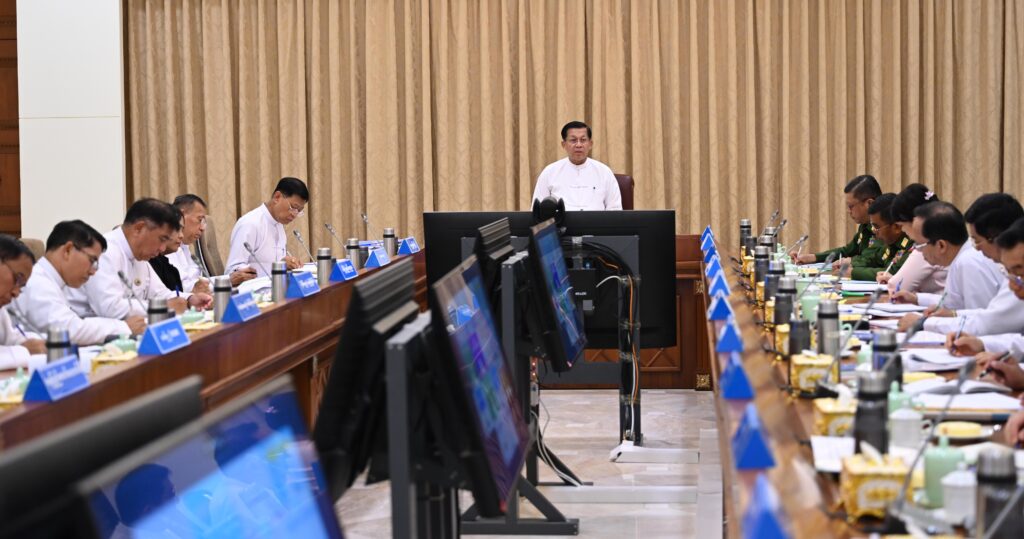
As the likelihood of an El Niño event occurring this year is high, extreme heat and drought conditions may occur from mid-2026 to mid-2027. Therefore, preparations must be made in advance from now on to prevent and mitigate these impacts, said President of the Republic of the Union of Myanmar U Min Aung Hlaing, who chairs the National Water Resources Committee, at the meeting hall of the President’s Office yesterday afternoon.
The President unveiled that plans are being developed and implemented to ensure the effective utilization of water resources and to address water scarcity during the summer season, as well as reduced river water levels caused by climate change. Efforts are also being made to draft and enact a National Water Law.
He noted that plans are being drawn up and implemented to ensure the efficient use of water resources and to address river water shortages caused by dry-season water scarcity and climate change. Efforts are also underway to draft and enact a National Water Law.
The President explained that more than 800 million acre-feet of freshwater flows annually through the four major rivers flowing across Myanmar, as well as other rivers and streams, large natural lakes, and wetlands. Therefore, it is necessary to explore opportunities for constructing low dams, generating hydropower, supplying drinking water in urban and rural areas, providing irrigation water for agriculture, and commercially producing water-related products in order to conserve and make effective use of freshwater resources.
He underscored that more than 100,000 megawatts of hydropower can be generated from rivers and creeks in Myanmar. Currently, some 3,500 megawatts are generated, accounting for only 3.5 per cent. Hence, it is necessary to attract investments in the hydropower sector of renewable energy.
In the agriculture sector, the President highlighted that some 15 million acres of farmland are placed under paddy in the monsoon across the nation, but about 2.71 million acres of paddy are planted in summer. Expansion of sown acreage is not important, but it is necessary to grow crops in the sown acreage to thrive.
He stressed the need to formulate the year-wise plans to supply water in villages of Sagaing, Mandalay and Magway regions where residents face scarcity of drinking water and agricultural water in summer.
He underlined that as the likelihood of an El Niño event occurring this year is high, extreme heat and drought conditions may occur from mid-2026 to mid-2027. Therefore, preparations must be made in advance from now on to prevent and mitigate these impacts.
The President urged ministries, regions, states and organizations to consider the possible impacts of natural disasters in the construction of infrastructure and residential buildings.
Committee Vice-Chairman and Union Minister for Transport U Mya Tun Oo, and the secretary reported on the formation of the committee, its objectives and responsibilities, implementation of the plans, supply of water and plans.
Union ministers, the Nay Pyi Taw Council Chairman, region and state chief ministers and mayors discussed the water-related work processes, development of water sources, international cooperation in water sources, water quality tests, river water pumping process, and supply of drinking and agricultural water.
In response, the President stressed the need to educate school-age children to understand the value of water and the impacts of water pollution from undisciplined disposal activities. It is necessary to conserve the Indawgyi and Inlay lakes as a national duty because these are global and local heritage sites.
The Vice-Chairman reported on the systematic use of water sources and the prevention of natural disasters.
The President remarked that, as there are also problems that can arise due to weather conditions, it is necessary to implement activities in accordance with the appropriate time periods. It is necessary to make preparations for situations that may arise in accordance with the country’s climatic conditions.
Also present at the meeting were senior Tatmadaw officers from the Office of the Commander-in-Chief, City Development Committee Chairs from Yangon and Mandalay regions and officials together with region and state chief ministers through videoconferencing.
MNA/TTA
#TheGlobalNewLightOfMyanmar