
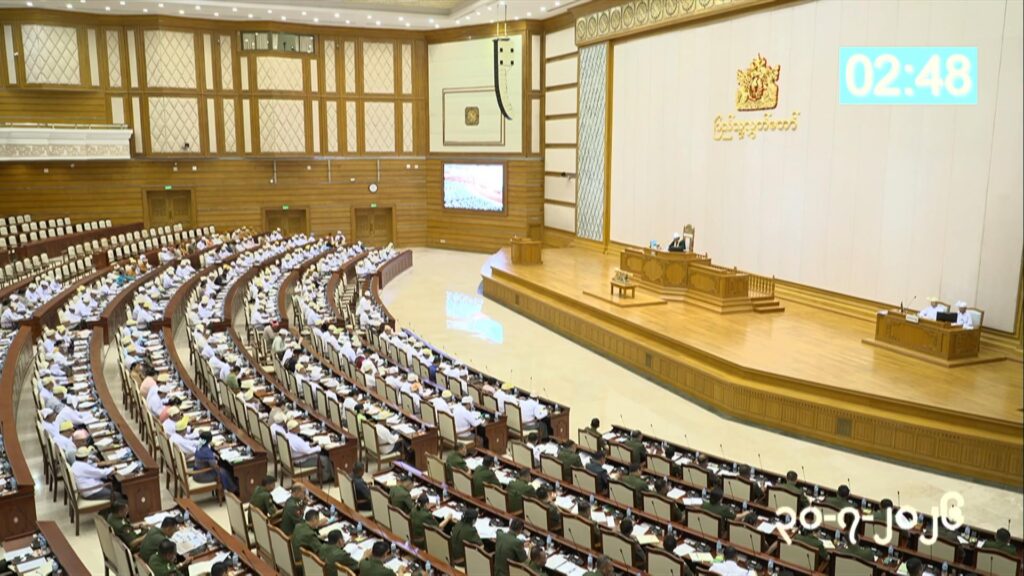
The Third Pyithu Hluttaw successfully concluded its second regular session yesterday after 32 sitting days, during which lawmakers focused on infrastructure, agriculture, housing and public services while raising hundreds of questions on national and regional development.
At the final day’s meeting in Nay Pyi Taw, Speaker U Khin Yi, Deputy Speaker U Maung Maung Ohn and members of parliament heard responses from deputy ministers on 12 questions covering agricultural laboratory staffing, irrigation projects, rice production, roads, bridges, public housing and transport infrastructure.
Deputy Minister for Agriculture, Livestock and Irrigation Dr Ye Tint Tun said laboratories under the Dawei District Agriculture Department would continue operating under the existing organizational structure. Instead of creating separate staffing positions, the ministry plans to train and assign qualified personnel through recruitment and promotion programmes.
The ministry also outlined plans to improve the Kinta Left Main Canal to strengthen irrigation for farmland in Wundwin, Myittha and TadaU townships. Deputy Minister for Agriculture, Livestock and Irrigation U Bo Bo Kyaw said upgrades would be implemented in phases, subject to funding from regional or Union budgets.
On agricultural production, the ministry announced targets to cultivate about 14.9 million acres of monsoon rice and 2.93 million acres of summer rice during the 2026-2027 financial year, with plans to gradually expand monsoon rice cultivation to over 15.1 million acres and summer rice cultivation to more than three million acres by 2030-2031. The ministry emphasized improving productivity, food safety, export competitiveness and farmers’ incomes rather than expanding cultivated land.
Deputy Minister for Construction U Myo Myint responded to a series of questions on roads and bridges across the country, outlining plans for road upgrades in Bago and Yangon regions, and Shan and Rakhine states, while also providing updates on proposed bridge projects and public housing initiatives. He said implementation would depend largely on annual budget allocations.
In his closing address, Speaker U Khin Yi reviewed the session’s achievements, noting that lawmakers had submitted 722 parliamentary questions, including 286 starred and 436 unstarred questions, as well as three motions. The questions covered a wide range of sectors, including transport, construction, agriculture, education, healthcare, energy, administration and regional development.
The Speaker also highlighted progress in legislative work, including discussions on amendments to the Political Parties Registration Law and the Pyithu Hluttaw Election Law, while an Anti-Online Scam Bill has already been debated in the Pyidaungsu Hluttaw and is expected to become law.
He said Hluttaw committees had continued reviewing legislation and engaging with ministries and stakeholders, while efforts were being made to improve public engagement through the parliament’s website, YouTube channel and TikTok platform, as well as visitor programmes and media briefings.
Looking ahead, the Speaker outlined a five-year strategy to modernize parliament by drafting new laws, reviewing outdated legislation, expanding public participation, promoting digital parliamentary systems and strengthening international parliamentary cooperation. He urged lawmakers to use the parliamentary recess to meet constituents, gather public concerns and return with proposals that address both regional and national priorities.
MNA/ST
#TheGlobalNewLightOfMyanmar