
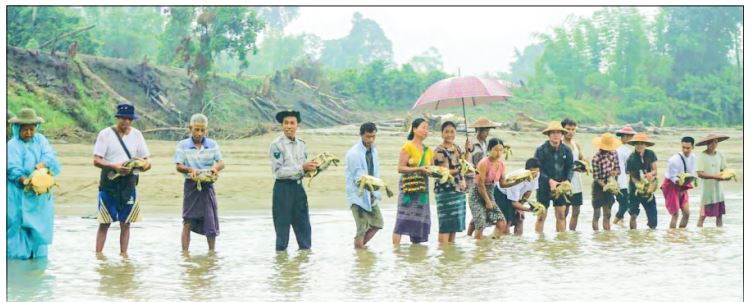
AMONG the 11 tortoise species found only in Myanmar, two globally endangered endemic species, such as the Burmese Star Tortoise and the Burmese Roofed Turtle, are being conserved as national biological treasures.
Myanmar, one of the countries rich in biodiversity, has abundant rivers, streams, lakes, and wetlands that support both land and aquatic wildlife. The endangered Burmese Star Tortoise is mainly conserved in the Mandalay, Sagaing, and Magway regions. This species typically mates between June and September and lays eggs from May to September, up to four times a year, with more than 15 eggs per clutch. Depending on natural habitat conditions, it can live for over 50 years.
Before 1999, the Burmese Star Tortoise was on the verge of extinction. It was rediscovered in protected natural areas, and conservation efforts were initiated to prevent its extinction and promote breeding in the Lawkananda Wildlife Sanctuary, Shwesettaw Wildlife Sanctuary, and Minnsontaung Wildlife Sanctuary. The population has grown to around 10,000 individuals. Authorities continue to prevent threats such as extreme heat, food scarcity, forest fires, habitat loss, and illegal trade.
“The original habitats of the Burmese Star Tortoise are the Minnsontaung Wildlife Sanctuary in Natogyi Township, Mandalay Region, and the Shwesettaw Wildlife Sanctuary in Minbu, Magway Region. They are also found at Myaleik Hill in PyinOoLwin. Before 1999, an American student discovered information about the species in a museum and came to Myanmar to conduct research in Shwesettaw. This brought global attention to the Burmese Star Tortoise. As an endemic species, it is essential for everyone to help conserve it,” said an official of Lawkananda Wildlife Sanctuary.
The Burmese Roofed Turtle inhabits the Htamathi Wildlife Sanctuary and sandbanks along the upper Chindwin River. It was first bred at Lawkananda Sanctuary in 2001. As an endemic species found only in Myanmar and the second rarest turtle species in the world, it is being conserved to prevent extinction, support research, and allow the public to study through collaboration efforts between the Forest Department and local communities.
Tortoises play an important ecological role by dispersing seeds and aiding plant and fungal reproduction, and transporting pollen and insects, thereby benefiting ecosystems and humans. Aquatic turtles help maintain water quality by consuming pollutants, algae, and aquatic insects, preserving ecosystems.
s in Myanmar, including five species of sea turtle, 22 species of freshwater turtles and four species of land turtles. Among the 11 tortoise species, the Burmese Star Tortoise and Burmese Roofed Turtle are endangered. Moreover, three new species, such as the leaf turtle, Burmese peacock softshell turtle, and Burmese softshell turtle, have been recorded. Due to illegal hunting and trade, these endemic species remain at risk of extinction, and conservation efforts are ongoing.
Nyein Thu (MNA)/KTZH
#TheGlobalNewLightOfMyanmar