
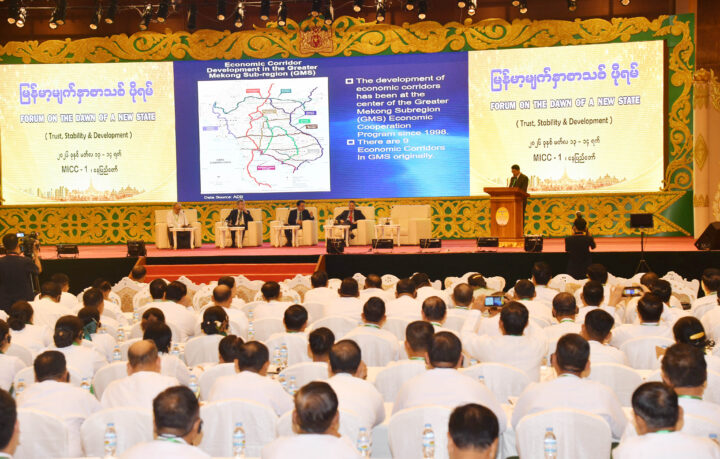
The Forum on the Dawn of a New State (Trust, Stability & Development) commenced the first-day session at the Myanmar International Convention Centre I (MICC I) in Nay Pyi Taw yesterday.
Speaking on the occasion, Union Minister for Information U Maung Maung Ohn said that participants will gain new perspectives from today’s forum on how to promote investment opportunities, ensure food security and long-term cooperation, develop small and medium-sized industries, and strengthen international economic collaboration. In addition, discussions will also cover the transition from an agricultural economy to an industrial economy, infrastructure and energy sectors, the digital economy and innovation, as well as human resource reforms.
He stressed that it is necessary to carefully assess strengths and weaknesses in the current global situation of numerous challenges and formulate sustainable long-term roadmaps.
He noted that it is essential to apply technology and innovation in transitioning from the agricultural sector to the industrial sector. In today’s era, the digital economy has become a global standard and will also enable Myanmar’s production value chains to become faster and more dynamic. As such, it is necessary to understand the development of energy and infrastructure as the lifeline of the industrial sector.
The Union minister presented 300 sets of MRTV DTHs, 286 sets of MRTV DVB T2 set-top boxes, 300 sets of Canal+ DTHs and 286 sets of Canal+ T2 set-top boxes to 157 Amyotha Hluttaw representatives, 263 Pyithu Hluttaw representatives and 166 Defence Services Personnel Representatives.
Dr Zaw Oo of Myanmar Narrative Think Tank presided over the first portion of the forum. He talked about the opportunities for economic linkage for a country, handling the unusual economic conditions, formulating policies to bring illegally operating businesses onto a legal and formal pathway, managing migrant workers to be able to contribute to the country as a brain gain, facilitating the inflow of migrant workers’ wages through formal remittance channels, ensuring the management of secure energy resources, and promoting the use of digital technology in the economic sector.
Professor Mr Lei Zhuning of Yunnan Academy of Social Sciences discussed enabling conditions and advantages for economic cooperation between Myanmar and China, agricultural cooperation and market expansion, and infrastructure connectivity.
Senior Professor Mr Mahendra P Lama of Jawaharlal Nehru University emphasized food security, production of value-added products, more production of organic crops, and energy projects for Myanmar.
Distinguished Economist and Academic Leader Dr Nisit Panthamit of Chiang Mai University talked about foreign exchange, import regulations, energy supply, financial flows, cybersecurity, and the Myanmar-Thai trade process.
Representative of Dale Carnegie & Associates Mr Luc De Waegh focused on the inflow of foreign investment to Myanmar, the role of Myanmar’s Telecommunications sector, and economic opportunities for Myanmar.
International experts made clarifications in detail in response to the questions raised by those from political parties, Hluttaw representatives, political researchers at home and attendees.
Dr Khin Maung Lwin from the Myanmar Narrative Think Tank presided over the second portion of the forum. He discussed ensuring inclusive development that encompasses the participation of all in promoting economic development.
Dr Zaw Oo from the Myanmar Narrative Think Tank highlighted macroeconomic conditions, recommendations for advancing Myanmar’s economic development, measures to stabilize commodity prices, the exchange rate, interest rates, and fuel prices, fuel-saving initiatives, causes of rising commodity prices and inflation, the relationship between exchange rates and the trade sector, Myanmar’s GDP growth rate, the growing shortage of basic labour, the establishment of a secure digital payment system; attracting foreign investment inflows; the economic impacts that may arise from illegal trade and conflict; and the implementation of Myanmar-style economic strategies.
Union Minister (Retd) U Tin Naing Thein talked about Nation Building and State Building, political ideologies and their role in nation-building, contemporary ideologies of nation-building, the will, desires, and aspirations of the people, the expectations of the government formed by the National Defence and Security Council, the expectations of the party winning the majority of seats in Hluttaw, the fundamental principles of the State, and maintaining checks and balances among the three branches of power to fulfill national economic interests and the socioeconomic aspirations of the people.
Executive Director U Tin Win Aung from Green Economy Green Group underscored the main components of a green economy, how the green economy can transform the agricultural sector, applying innovative ideas to develop the agricultural sector, plans for food security and rural development, Myanmar’s socioeconomic development and the green economy, and the inclusive, multi-sectoral, and cross-sectoral participation including the private sector in implementing government-formulated strategies.
Those speakers replied to queries raised by those from political parties, Hluttaw representatives, local political researchers and attendees.
MNA/TTA
#TheGlobalNewLightOfMyanmar