
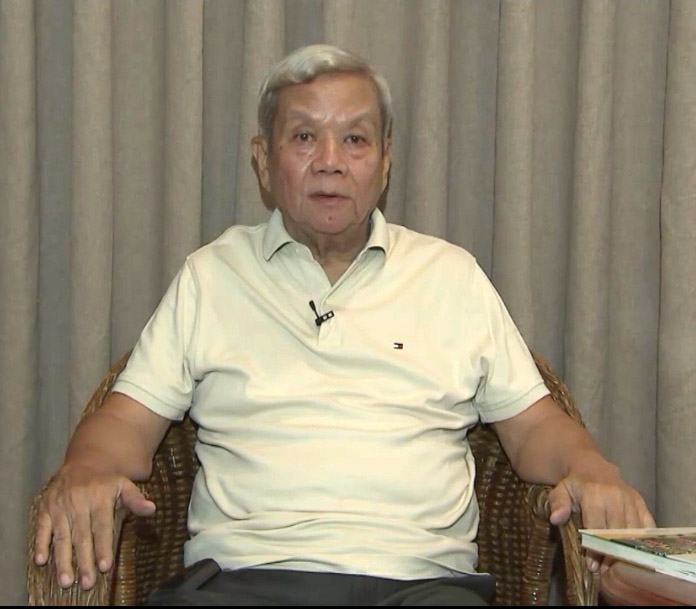

“Looking at this pattern, Bengali people live in both Bangladesh and Myanmar, and in Myanmar, the term ‘Rohingya’ is used. This is what Brig-Gen Aung Gyi meant in his speech, referring to the people living on both sides of the border.” (Associate Professor Dr Sint Sint Myat)
“Following this incident, UNHCR referred to it as a fact-finding mission and formed a team to investigate. However, when I read the report, I found that the facts were not recorded at all. Instead, the report relied on interviews with refugees in the camps. In my view, it presents the opposite of reality.” (Retired Colonel Maung Maung Nyein)
The hearings in the case between The Gambia and Myanmar are taking place at the International Court of Justice in The Hague, the Netherlands, from 12 to 29 January. Below are statements from Colonel Maung Maung Nyein (Retd), who served in Rakhine State, and Dr Sint Sint Myat, Associate Professor, Department of International Relations at the Yangon University of Foreign Languages (YUFL).
Colonel Maung Maung Nyein (Retd)
(Formerly served in Rakhine State)
I was transferred to No 263 Light Infantry Regiment in Buthidaung Township in 1993, where I served as a commanding commander. I spent about three years there. At that time, the Border Region Immigration Control Headquarters Na Sa Ka had just formed, and there were many Bengali villages around our regiment. During that period, we worked well with the Bengalis and carried out the Na Sa Ka operations together.
The incident I am referring to occurred in Rakhine State in 2017. I would like to say that when we lived in Rakhine State earlier, the Bengalis were not like this. So why did these things happen? Because I could not understand it, I personally went to the Buthidaung-Maungtaw region in 2018. I travelled throughout the area, from Rathedaung in the south to Maungtaw in the north, and interviewed Rakhine ethnic people, Bengalis, and Maulavis and monks who had experienced the incident. I have records of all these interviews.
Another major incident occurred when Bengalis entered Yebaukkya village and killed 144 people from the entire village. They also took seven girls from there. The intention was to use these seven girls as evidence once they reached the other side. It was a staged incident, in which the killings were carried out in a way that made it appear Tatmadaw was responsible, while the perpetrators escaped under the pretense of being pursued by Tatmadaw.
Fortunately, these girls escaped from the Kutupalong refugee camp in Bangladesh. I met them in person and interviewed them. Through these interviews, I learned the true story, which led me to write a book documenting it. This book is a research-based work.
The book is titled ‘Bengalis Trying to Migrate with Dignity’, and I later gave it the title ‘Displacement with Dignity’. The title was inspired by a research paper written by two lawyers in Australia, which argued that due to climate change, people in Bangladesh are seeking to migrate with dignity to neighbouring countries. That is why I chose that title for my book.
The main point is that this project was carried out with premeditation. We have also released a video recording presenting the true story of the Yebaukkya village incident. What I later discovered was that before this incident, during security operations in the area, the army found a laptop in a Bengali camp. The laptop contained numerous records showing that these Bengalis had travelled to Saudi Arabia for military training for two to three years before the incident.
On another occasion, in the Buthidaung-Maungtaw region, we observed caves being dug along the Meyu Mountain Range and training activities taking place inside them. From this, it was clear that these actions were premeditated.
Following this incident, UNHCR referred to it as a fact-finding mission and formed a team to investigate. However, when I read the report, I found that the facts were not recorded at all. Instead, the report relied on interviews with refugees in the camps. In my view, it presents the opposite of reality.
The report claims, for example, that Tatmadaw killed about 10,000 Bengalis, among other allegations. These claims are greatly exaggerated and unsupported by solid evidence. There is not a single photograph to substantiate them. In this era, when almost everyone has a phone, there is still not a single video file to support these claims.
On the other hand, there was a major Fact-Finding Mission (FFM) report that relied solely on oral testimony. Based on that report, the OIC brought The Gambia into the picture and subsequently took the case to the International Court of Justice (ICJ). In this context, the Independent Commission of Enquiry (ICOE), headed by a deputy minister from the Philippines, came to our country to examine the facts. During the investigation, we were able to present evidence to support our account. The international media reported extensively on this. As I could no longer remain there, I went to Thailand and held a press conference with various news organizations. I presented the facts, and the Thai state broadcaster also interviewed me due to its interest in the issue. The transcript of that interview was later released. What actually happened is very different from what is commonly claimed.
The next development involved a journalist who is a former Syrian citizen and now an American citizen, whose news agency was highly respected. He came to Yangon, and when he arrived, I explained everything to him. I told him, “You are a Muslim yourself. Go and see the real situation on your own, without being guided”. I advised him to visit the mosque, the market, and the surrounding areas. I asked him to observe how many Rakhine people were selling goods in the Maungtaw market. There were none; they were all Bengalis. I told him to speak with Bengalis working in the fields and to visit the schools, where he would also see them.
When he returned, what he told me was completely different from what he had expected. He said that while security in Rakhine was not good, people were living peacefully. He personally went to the mosque and met religious leaders. As a Muslim himself, he saw with his own eyes that Bengalis were able to live and work freely. His news agency later released a video documenting this, which was distributed internationally.
What I want to emphasize is that these Bengalis are not citizens of our country. They have no proof of citizenship. Nevertheless, Myanmar grants non-citizen Bengalis the right to education, employment, and medical treatment. He saw clear evidence that our government treated non-citizens in the same way as its own citizens. To sum up, this Bengali issue is a premeditated and well-planned process. Its main objective is to place our government in a political trap and ultimately force the acceptance of these non-citizen Bengalis.
In our country, we maintain precise records of Bengalis, including detailed lists, photographic records, and fingerprint records. According to our data, about 400,000 people fled from our country to Bangladesh, and currently, more than 400,000 Bengalis remain in Rakhine State. This means that more than half of them fled. However, the number of Bengalis in the Kutupalong refugee camp is estimated at about 1.5 million. I do not know where the rest came from. This suggests that a large number of Bengalis may return to this country.
Myanmar and Bangladesh have a readmission agreement, under which we will accept only those who actually fled from Myanmar. Our position is clear: returnees must provide evidence that they lived here and fled from Myanmar. Only those who can do so will be accepted. However, we have observed demands that Myanmar must accept all Bengalis indiscriminately and grant them citizenship.
The issue at Myanmar’s western gateway, in the Bengali region, poses a major challenge for the country. There is no solid evidence, yet the ICJ is addressing a case based largely on oral testimony. In fact, when we examine the legal process, it appears that justice is lacking.
Dr Sint Sint Myat
Associate Professor, Department of International Relations
Yangon University of Foreign Languages (YUFL)
Today, I will discuss the use of the word “Rohingya” in a speech delivered by Brig-Gen Aung Gyi at the 1961 surrender ceremony of the Mujahid armed groups.
The first point I want to make is that when Brig-Gen Aung Gyi used the word “Rohingya,” he did so as a concession to the government’s authority, in response to the Mujahid armed groups’ demand to be referred to as Rohingya rather than Bengali.
Secondly, when using this term, Brig-Gen Aung Gyi did not intend to suggest that the Rohingya, as claimed by the Mujahid, are distinct from the Bengalis living in the border areas of Bangladesh.
Third, ethnic groups live along the borders with Myanmar on both sides. For example, just as the Lisu, Iko, and Lawa people live along the border with China, the Tai, Mon, and Kayan people live along the border with Thailand. Therefore, it is not only along the Meyu border, previously known as northern Rakhine State, that Bengali people live on both sides. Historically, other ethnic groups have lived along the borders with China, Myanmar, and Thailand. For instance, in Myanmar, they are known as the Shan, while in China, they are called the Tai. Looking at this pattern, Bengali people live in both Bangladesh and Myanmar, and in Myanmar, the term “Rohingya” is used. This is what Brig-Gen Aung Gyi meant in his speech, referring to the people living on both sides of the border.
In the meantime, I would like to discuss the use of the word “Rohingya” in the speech of Brig-Gen Aung Gyi and the information found in the Rohingya programme of the Myanmar radio service. First, I will address the origin of the Rohingya broadcast programme. Since World War II, programmes related to foreign ethnic groups have been broadcast in Burma. For example, there were Tamil-language programmes, Bengali programmes, and Hindustani programmes.
However, in 1961, at the request of Brig-Gen Aung Gyi and the Mujahid armed groups, the Bengali-language programme was renamed the Rohingya programme, because the term “Rohingya” was used instead of “Bengali”. According to our findings, at that time, the Myanmar radio had two separate types of programmes: ethnic-language programmes and border-region ethnic programmes. Since the Rohingya programme (originally called Bengali) was not considered an ethnic-language programme, it was included under border-region ethnic programmes, as was also reported in the daily newspapers of 1961.
The News Team
#TheGlobalNewLightOfMyanmar