
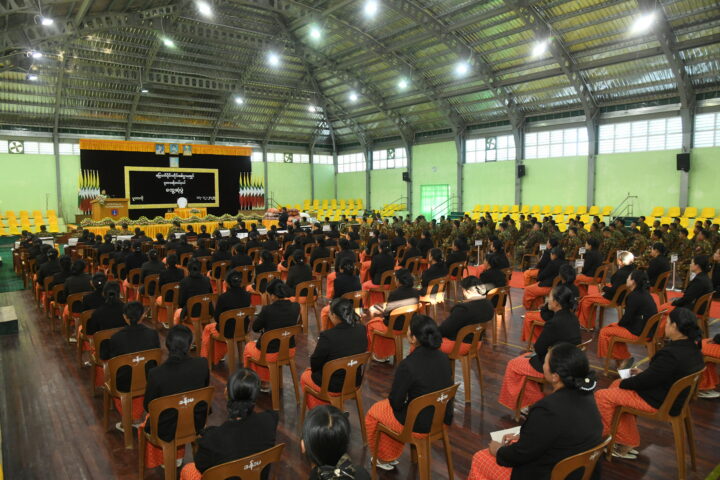
State Security and Peace Commission Vice-Chairman, Deputy Commander-in-Chief of Defence Services, and Commander-in-Chief (Army) Vice-Senior General Soe Win met officers, other ranks, and family members of the PutaO Station at the military headquarters in PutaO yesterday afternoon and delivered a speech.
The meeting was attended by senior Tatmadaw officers from the Office of the Commander-in-Chief (Army), the Commander of the Northern Command, officers from the PutaO Station, soldiers, and family members.
State Security and Peace Commission Vice-Chairman, Deputy Commander-in-Chief of Defence Services, and Commander-in-Chief (Army) Vice-Senior General Soe Win first delivered a speech stating that Tatmadaw members recite the Four Oaths every day and therefore must remain loyal to the oaths, to their country, to their citizens, and to their fellow service members. He emphasized that the primary responsibility of the Tatmadaw is to protect the nation and that it is their duty to defend the country’s territorial land, waters and airspace from any invasion, not allowing even an inch to be encroached upon.
To achieve this, Tatmadaw needs to be strong and possess three capabilities: the ability to apply military skills acquired through an individual fighting spirit that remains bold despite any challenges. These qualities must be balanced with individual combat capabilities on the battlefield in order to enhance the organization’s overall fighting capacity.
In order to achieve this, it is necessary to practise the military skills that have been taught and to continually study evolving military strategies. Since effective combat requires strength and good health, daily physical training must be carried out consistently. Personnel should adhere to the motto of “Study, Practise, and Comply” regarding the military skills and strategies they have been trained in. Only through repeated practice can they become proficient and confident, enabling them to fight with courage and determination when required. During training, it is essential that both individual and collective exercises be properly supervised by those responsible, and that the “three always” principle be upheld: always training, always maintaining military awareness, and always being ready to fight.
Regarding administrative matters, officials in charge of battalions and units should provide support for the livelihoods, transportation, education, healthcare, and other needs of officers, soldiers, and their family members. They must ensure that all necessary provisions are supplied and properly supervised so that entitlements are delivered correctly and in full, thereby safeguarding their welfare. Only under these conditions can duties be performed with mutual respect and trust between superiors and subordinates, and with peace of mind. Officials should follow the constant guidance of the Defence Services Commander-in-Chief, namely the four principles of “doing what one should do”. To enable Tatmadaw members to fulfil their national defence responsibilities, it is especially important to maintain complete unity both within the Tatmadaw and between the Tatmadaw and the people.
Vice-Senior General Soe Win emphasized that Tatmadaw will conduct the upcoming free and fair multiparty democratic general election. Special care will be taken to prevent voting fraud, like that which occurred in the 2020 election; accordingly, the Myanmar Electronic Voting Machine (MEVM), a digital voting system designed to prevent electoral fraud, will be used. This system has also been observed in use in elections in other countries. Since regional stability is essential for voters to cast their ballots peacefully, security operations must be conducted jointly by Tatmadaw, the Myanmar Police Force, local militia groups, public security and counterterrorism units, volunteers, village elders, and residents.
When voting, it is important to choose and cast ballots for representatives who are like-minded and able to work together with the Tatmadaw, who uphold the Three Main National Causes, who serve the interests of their region, who possess good moral character, who are healthy and strong, and who are capable of leading their organizations.
He also stated that, regarding education, the current population of our country is over 51 million, according to the 2014 Population and Housing Census. Of this population, 9 out of 10 children, or 90 per cent, are attending school. The school-age population, defined as children aged 10 to 14 years, accounts for 94.8 per cent of children. Of these, 45.3 per cent are at the basic education level, 15 per cent are at the secondary level, and only a small percentage are enrolled at the university level, with almost none above the age of 25. Given the many weaknesses in grade transitions in our country, it is essential to work together to ensure that all children in our districts can progress smoothly through each grade. Additionally, we must provide the necessary support to help students from our districts who will sit for the Grade 12 examination in March 2026 achieve excellent results.
Afterwards, based on the presentations made by the families of the officers and other ranks who attended, the State Security and Peace Commission Vice-Chairman, Defence Services Deputy Commander-in-Chief, and Commander-in-Chief (Army) coordinated with the officials to provide food and honorariums to the officers, soldiers, and their families, which were distributed through the officials.
After the meeting, Vice-Senior General Soe Win cordially greeted the officers, other ranks, and their family members who attended.
MNA/TH
#TheGlobalNewLightOfMyanmar