
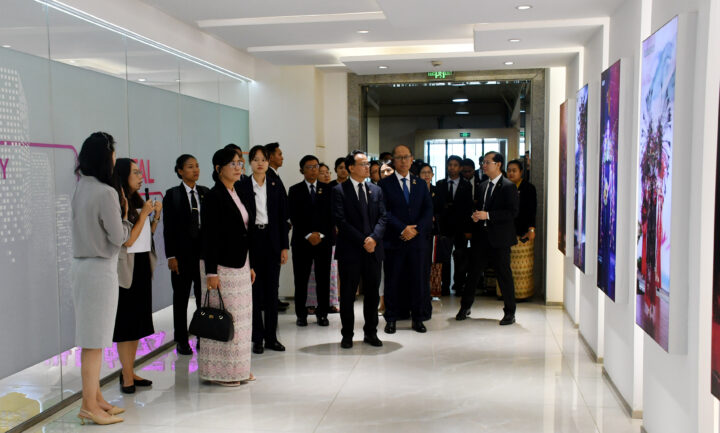
Vice-President of the Republic of the Union of Myanmar Nan Ni Ni Aye led the Myanmar delegation to visit the South-East Tibet Museum and the Yani National Wetland Park in Nyingchi (Linzhi), Xizang Autonomous Region, People’s Republic of China.
On arrival at the Southeast Tibet Museum, the museum official clarified on the museum’s history, ancient cultural heritage, traditional artefacts of various ethnic groups, costumes, silverware, lifestyles and customs of ethnic communities, sports, and historical events displayed in the galleries. The Vice-President asked questions on matters of interest before touring the museum.
The South-East Tibet Museum one of the region’s landmark museums, showcasing the history, culture, ethnic traditions, archaeological heritage and ecological features of southeastern Tibet.
At the Yani National Wetland Park in Nyingchi (Linzhi), the official explained the park’s environmental conservation efforts, forest and watershed management, biodiversity protection, ecosystem restoration programmes and initiatives to promote nature-based tourism. The Vice-President raised questions on matters of interest and toured the park’s nature trails, viewing platforms, the Yarlung Tsangpo River and its surrounding natural scenery. Located along the banks of the Yarlung Tsangpo River, the national wetland park is a prominent ecological area that preserves high mountain ranges, lush forests, wetlands and rich biodiversity in their natural state.
On 15 July, the Vice-President and party visited the Dounan Flower Market in Kunming, Yunnan Province, China. Market officials explained the market’s development, flower production and distribution processes, flower auction system, e-commerce operations and international export activities. The Vice-President asked questions on matters of interest before touring flower exhibition halls, the flower auction centre, quality inspection facilities, packaging operations, modern technologies used in the floriculture industry, digital management systems and logistics processes.
The Dounan Flower Market, established on 18 August 1998, now covers more than 6,000 acres of flower cultivation. It is the largest flower wholesale and retail market in Asia and the second largest in the world. The market trades a wide variety of flowers, including roses, lilies, carnations and orchids, which are distributed daily across China and exported to South-East Asia, South Asia, Europe and other regions.
MNA/KTZH
#TheGlobalNewLightOfMyanmar