
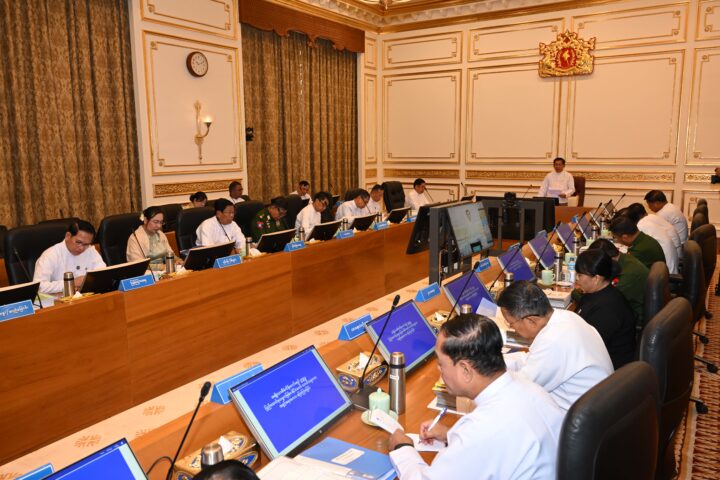
Acting President of the Republic of the Union of Myanmar and State Security and Peace Commission Chairman Senior General Min Aung Hlaing, who is in the capacity of Chairman of the National Planning Commission, said so at the meeting 1/2026 of the National Planning Commission at the office of the National Defence and Security Council in Nay Pyi Taw yesterday morning.
Speaking on the occasion, the Senior General noted that economic development, education, health, and peace and stability are the aspirations of all citizens. As the government emerges from the election results, it must also fulfil the needs of the people. To enable this, the current plan must lay the groundwork and ensure a smooth transition for implementation.
For the country’s development, he said that both short-term and long-term plans must be formulated by carefully considering potential scenarios in politics, economics, administration, and defence, and by taking a broad perspective in the planning process.
He emphasized that when formulating policies, the necessary baseline data must be obtained, analyzed, and utilized from the relevant sections of the 2024 Population and Housing Census results. Since population policy is important, plans must be developed and implemented in the Union, regions, and states based on projected population changes, age distribution, labour force, education, health, and other related data.
The Senior General highlighted that since the new government will soon assume the responsibilities of the State, it is necessary to ensure that the projects and plans carried out under our tenure from 2021, according to each financial year, are completed properly. In addition, ongoing projects from previous periods must be systematically documented and handed over.
He underlined that efforts will also continue nationwide to quickly rebuild the basic infrastructure that was damaged due to terrorist activities and natural disasters, in order to promote regional development and progress.
With regard to managing the nation’s limited resources for development, the Senior General stressed that all available domestic resources must be used efficiently and effectively without waste. Therefore, State expenditures must be carefully managed to avoid unnecessary spending. All responsible authorities must lead efforts not only to promote economic growth but also to ensure the long-term emergence of a resilient Myanmar society in the future.
He stated that the National Plan for the 2026-2027 financial year will be implemented by the incoming government in coordination with the relevant Hluttaw’s agreements. The government and Hluttaws will work together to coordinate and ensure the achievement of the plan’s objectives by sector and by region.
He underscored that if school education is weak, it can also create gaps in vocational and technical training. It is necessary to improve general education so that advanced skills and technical knowledge can be acquired. Skilled professionals in key sectors such as agriculture and livestock are still in high demand, and this factor must be taken into account when formulating national plans.
The Senior General pointed out that efforts have been made through various means to improve the socioeconomic lives of rural residents and to reduce poverty. It is not only necessary to provide employment opportunities but also to ensure that people can genuinely engage in productive work.
He unveiled that price increases can occur due to imbalances between production and consumption and high production costs. However, if efforts are made to ensure a sufficient local supply of essential goods, vegetables, fish, and various types of eggs in each region, these price increases can be mitigated. Moreover, selling any surplus to external markets can help improve the socioeconomic well-being of the region.
He provided guidance that the National Planning Commission must also consider ensuring an adequate supply of oil crops and the reliability of the electricity and energy sectors.
He stated that the projects included in the 2026-2027 National Plan will be implemented in accordance with the agreements of the Hluttaws. The government has to make efforts to ensure that all citizens patiently achieve the expected objectives.
National Planning Commission Vice-Chairman and Prime Minister U Nyo Saw reported that the national planning for the 2026-27 financial year has been formulated for the prosperity of the State, food security, socioeconomic development of the people and all-inclusive sustainable development of the people. In accord with the guidance of the State, the plan aims to develop infrastructure, primary livelihoods of the rural people, agriculture and livestock sectors, MSME business, increase export volumes and initiate the education system for all to develop human resources, improve healthcare services, electricity and energy sectors, as well as maintain the natural environment.
Likewise, he added that the plan has allowed construction, natural disaster prevention and environmental conservation as well as development of agriculture, industrial, electric power, education and health sectors.
National Planning Commission Secretary Union Minister for Finance and Revenue Dr Kan Zaw briefed the meeting on the drafting of the National Plan 2026 and the National Plan Law (Draft) for the 2026-27 financial year.
Union Ministers also reported on the national plans for the relevant financial years and accomplishments.
Also, present at the meeting were the Union Auditor-General, the Chairman of the Union Civil Service Board, the Governor of the Central Bank of Myanmar, the Nay Pyi Taw Council Chairman, deputy ministers and chief ministers of regions and states and chairmen of Self-Administered Zone and Division Leading Bodies through videoconferencing.
MNA/TTA
#TheGlobalNewLightOfMyanmar