
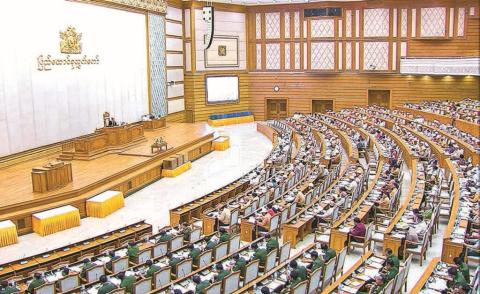
A New Chapter for Democracy: Myanmar’s Hluttaw after the 2025 Election
By Dr Than Zaw Oo
Following the historic 2025 multiparty democratic general election, widely regarded as free and fair and conducted using electronic voting machines, Myanmar has embarked upon a new chapter in its democratic journey. The general election was held in three phases: the first phase on 28 December 2025, the second phase on 11 January 2026, and the third phase on 25 January 2026. A total of 57 political parties and 86 independent candidates contested the election, including six political parties that competed nationwide and fifty-one political parties that participated in state- and regional-level elections.
As a result, 263 representatives were elected to the House of Representatives (Pyithu Hluttaw) and 157 to the House of Nationalities (Amyotha Hluttaw). Of those elected to the Pyithu Hluttaw, 230 were men, and 33 were women. While in the Amyotha Hluttaw, 133 men and 24 women secured seats. This election, widely regarded as free and fair, represents a significant step in strengthening democratic Hluttaw stands as a cornerstone of democracy, and this significance was reaffirmed governance in Myanmar.
After the historic 2025 election, Myanmar saw a pivotal moment as the Pyithu Hluttaw convened for the first time on 16 March 2026, and then on 18 March 2026, the Amyotha Hluttaw also held its first Hluttaw session, making another significant step for the country. During these inaugural sessions, U Khin Yi was elected the Speaker of the Pyithu Hluttaw, with U Maung Maung Ohn becoming the Deputy Speaker. In the Amyotha Hluttaw, U Aung Lin Dwe was elected the Speaker, and Jeng Phang Naw Taung was the Deputy Speaker.
The election itself was a vital milestone for democracy in Myanmar, as it gave the people a genuine voice.
As the Hluttaw now organizes its first standing committees, these bodies will play a key role in shaping policy, ensuring accountability, and fostering debate. The Hluttaw now moves forward with the formation of standing committees, which will play a crucial role in the legislative process, policy discussions, and ensuring accountability. As a primary pillar of democracy, the Hluttaw reflects the will of the people and strengthens democratic governance in Myanmar. In this way, the Hluttaw is not just a symbol, but a vital engine of democracy, propelling Myanmar forward as it embraces a new era of governance.
With the election of the Speakers and Deputy Speakers and the formation of standing committees, the Hluttaw has become vibrant and active. At the same time, questions have begun to arise about what takes place inside the Hluttaw and how its operations are processed. These questions reflect a growing interest in Hluttaw procedures, legislative functions, and the roles performed within the chambers.
Hluttaw serves as the legislative pillar of the state, with its primary responsibility being the enactment of laws. It plays a crucial role in maintaining the exercise of checks and balances across the executive, legislative, and judicial branches. Through mechanisms such as raising questions and submitting motions, Hluttaw reflects the voice of the people. In the process of Hluttaw questioning, Hluttaw representatives may raise both starred and unstarred questions. Starred questions require oral answers from the relevant Union ministers within the Hluttaw chamber, allowing for further clarification and supplementary questions. In contrast, unstarred questions are answered in writing by the respective ministries.
The principle of the separation of powers remains fundamental to democracy. Under this system, the legislative, executive, and judicial branches function independently while maintaining checks and balances. Among them, the legislative pillar, represented by the Hluttaw, plays a central role in lawmaking, representing the will of the people.
A strong and effective Hluttaw will be essential in consolidating democracy, upholding the rule of law, and ensuring that the voices of the people are reflected in national decision-making and ensuring accountable governance. This marks not only a political transition but also the beginning of a new era of democratic development for the nation.
As Myanmar move forwards, the strengthening of Hluttaw institutions will be essential in deepening democratic practice, upholding the rule of law, and ensuring accountable governance. A vibrant and responsive Hluttaw not only embodies the will of the people but also serves as the foundation upon which a stable, inclusive, and enduring democracy can be built. In this new era, the continued commitment to democratic principles will determine the nation’s path towards lasting peace and development.
#TheGlobalNewLightOfMyanmar