
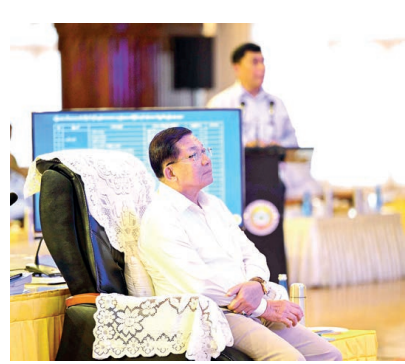
ARMED terrorism is destroying the interests of the relevant areas and the local people, obstructing and undermining the future of the regions and the nation, said President of the Republic of the Union of Myanmar U Min Aung Hlaing at the meeting with cabinet members of Yangon and Bago regions along with departmental officials at the Yangon Region government office yesterday afternoon.
Speaking on the occasion, the President underscored that as different political ideologies that emerged in the past could not resolved politically, and some groups chose the path of armed terrorism, stability and peace are still needed in some areas of the country. As the State is now moving forward on the path of multiparty democracy under the leadership of an elected government chosen by the people, political differences should be resolved and addressed through democratic means.
He noted that armed terrorism is destroying the interests of the relevant areas and the local people, obstructing and undermining the future of the regions and the nation. So, resolving issues through armed terrorism is not a genuine solution.
The President expressed his economic policy that if products are identical, owned products must be cheaper, and if prices are the same, their quality should be superior. In carrying out agricultural, livestock breeding, and manufacturing activities, it is necessary to ensure the accuracy of statistical data and to conduct production processes properly and efficiently.
He added that rising commodity prices are caused by imbalances between supply and demand, in addition to high production costs. Therefore, it is necessary to sufficiently produce goods domestically.
The President urged authorities of Bago Region to expand fish farming activities, while Yangon Region must emphasize larger production of meat and fish.
Regarding domestic edible oil sufficiency, the President underlined that edible oils have to be imported annually from abroad, resulting in the expenditure of foreign currency. Although oilseed crops are successfully cultivated and produced in the country, per capita domestic consumption of edible oil remains high. Therefore, it is necessary to reduce edible oil consumption.
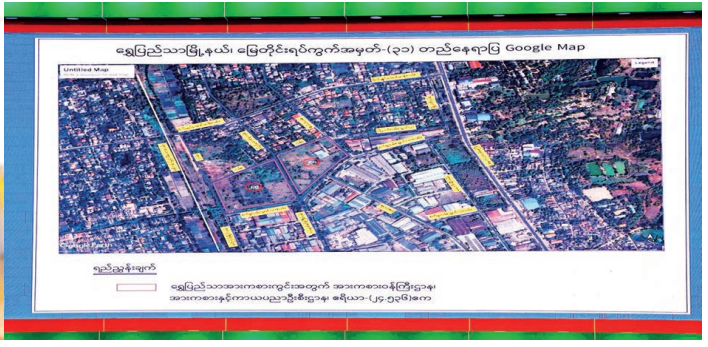
In the land utilization sector, the President emphasized that it is necessary to carry out construction tasks on the allotted land plots for infrastructural development. Likewise, land allocated for agriculture, livestock breeding, and industrial activities must also be utilized effectively and systematically in accordance with the approved purposes and permissions.
In the education sector, the President outlined that weaknesses in education were also partly due to the practice of placing greater emphasis on students advancing to the next grade level rather than on ensuring that they had actually acquired knowledge and skills. Therefore, since assuming state responsibilities in 2021, priority has been given to improving the quality of education in both basic education and higher education sectors. Teachers need to train their students to have genuine mastery of the subjects taught according to their respective grade levels and academic disciplines.
The President highlighted that only by producing quality human resources equipped with comprehensive knowledge, skills and proper, sound thinking can a developed and prosperous future nation be built.
With regard to the healthcare sector, the President stressed that policies such as “Where there is a hospital, there must be doctors; nothing is more important than human lives” have been adopted, and emphasis is being placed on enhancing the healthcare services provided to the people.
He continued that measures must also be taken to ensure that the surroundings around schools provide a healthy and balanced environment, and that food and drinking water are clean and safe.
Regarding the development of the tourism sector, the President pointed out that Yangon and Bago regions have many prominent pagodas, temples and stupas, ancient cultural heritage buildings, and beautiful natural surroundings that attract international tourists. Everyone needs to participate in efforts to beautify their regions and give good services in order to improve the tourism industry.
At the meeting, Yangon Region Chief Minister U Aung Naing Thu and Bago Region Chief Minister U Myo Swe Win reported on efforts for the development of their regions. They presented the systematic installation of communication and electric cables, proper drainage system, formation of town plans without reduction of farmlands, export of paddy and surplus rice, beans, seafoods, irrigation facilities for cultivable lands, cultivation of oil crops and coffee, storage of water at dams, efforts to control flooding and overflow of water, encouragement to MSME businesses, conducting vocational courses to develop human resources, and development undertakings at Toungoo Special Development Region.
After the meeting, the President cordially greeted the attendees.
MNA/ TTA
#TheGlobalNewLightOfMyanmar