
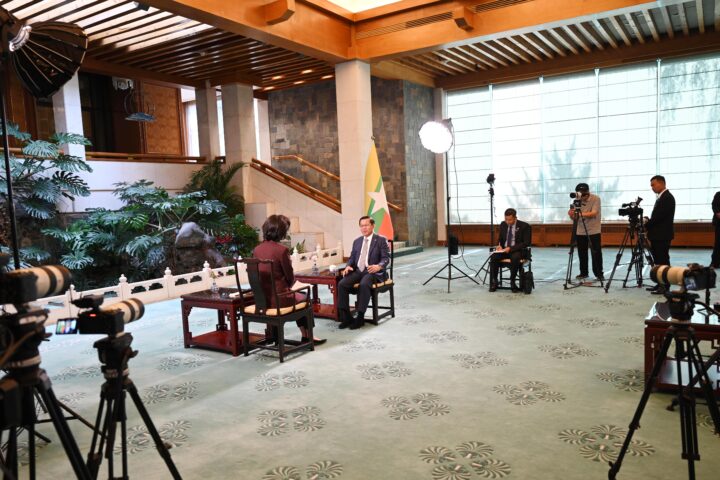
President of the Republic of the Union of Myanmar U Min Aung Hlaing, during his State Visit to China at the invitation of Chinese President Mr Xi Jinping, gave an interview to Ms Zou Yun, the top news presenter of CCTV news agency at the reception hall of the Diaoyutai State Guest House on 17 June. The full test of the translated answers of the President to CCTV news agency is as follows:
Interviewer: Hello, President U Min Aung Hlaing. This visit marks your first goodwill trip to China since assuming office as President in April. Accompanying you on this visit are six Union-level ministers and several senior military officials. So, I notice it is a high-level delegation. What outcomes do you hope to achieve from this goodwill visit to China?
President U Min Aung Hlaing: That is correct. Since I assumed my responsibilities as Head of State on 10 April, I have sought to strengthen relations further between our new government and China. At the invitation of President Xi Jinping, I have come to China with that objective in mind. The main purpose of this visit is to enhance comprehensive cooperation with China in support of Myanmar’s development and progress. We aim to expand cooperation across various sectors between Myanmar and China, encourage Chinese investment in Myanmar, promote bilateral trade, and strengthen collaboration on border security and stability. As we are countries with “Pauk-Phaw” (fraternal) relations, this is my first official state-level goodwill visit to China.
Interviewer: Mr President, you said that China and Myanmar share a long common border and are trustworthy friends. You also noted that the two countries are partners in building a community with a shared future, standing together through both good times and difficult times. How do you view this relationship?
President: Myanmar and China have enjoyed a long history of relations. Our friendship did not begin recently; we have long been good neighbours. The two countries share a border of more than 2,000 kilometres. As you have just mentioned, our countries are Pauk-Phaw (fraternal) nations. We have reached an agreement to build a community that shares both opportunities and challenges, as well as mutual benefits. Therefore, I believe that relations between Myanmar and China are not based solely on our shared border. They are also founded on the longstanding friendship and goodwill between our two peoples. For that reason, we should continue working to strengthen and enhance our bilateral relationship.
Interviewer: Our President, Xi Jinping, has also referred to the Myanmar-China relationship as Pauk-Phaw (fraternal friendship). In Chinese, the term is rendered as baobo. This Chinese expression is derived from the Myanmar term Pauk-Phaw, which symbolizes kinship or fraternal ties. How do you view this expression and its significance?
President: This is closely related to my earlier answer. Myanmar and China share a long history of relations. The term “relatives” refers to people connected by blood ties. In essence, such a relationship symbolizes a close and trustworthy bond. Within a family, there are brothers and sisters, parents, nephews and nieces – all of whom belong to the same family circle. Likewise, the term Pauk-Phaw conveys kinship and familial closeness. The expression Pauk-Phaw has long been used to describe the relationship between Myanmar and China because it reflects the view that the peoples of the two countries are bound together by ties akin to those of relatives and family members.
Interviewer: Mr President, you have met Chinese President Xi Jinping on many occasions. How do you view him, and what kind of leader do you think he is?
President: President Xi Jinping is not only a leader genuinely committed to improving his country but also someone whose views reflect a desire for a world where all people are treated equally and live in harmony. From my discussions with him, I have seen that he supports the idea of building a community with a shared future, where countries stand together through both good times and difficult times. Whenever I meet him, he consistently emphasizes the importance of peace, stability, security and development. I have noticed that these are themes he almost always raises during our meetings. I have visited China many times. My first visit was in 2007. After that, I did not return after 2019 until I visited again in 2024. When I first came to China, President Xi was serving as Vice-President. Later, after he became President, we continued to meet and hold discussions. Over the years, I have observed tremendous changes throughout China. Every region has undergone significant development. China is a vast country, both in terms of territory and population. With a population of more than 1.4 billion people — roughly one-fifth of the world’s population — it is no easy task to ensure balanced development and progress for all. Achieving that requires exceptional leadership. I have seen the capability and vision of China’s leadership, and for that reason, I have great admiration for President Xi Jinping.
Interviewer: Mr President, it is understood that you have previously visited China. Based on that experience, how do you understand the essence of Chinese modernization and the path it follows?
President: This is related to my previous answer. Modern China has made remarkable progress. Its development has been extremely rapid, and the pace of advancement is impressive. Whenever a new technology emerges and makes the news, by the time we study it, another innovation has already appeared. This reflects the hard work and dedication of China’s younger generation. We can see that Chinese young people are energetic, ambitious and highly motivated. They have a strong desire to work, innovate and achieve results. As a result, progress can be seen everywhere. I have visited not only the places you mentioned but also many other provinces across China. Almost all of them have experienced significant development. One more point I have observed is that development is relatively balanced. The differences are not excessive. The conditions in Beijing, Shanghai, Chongqing and Guangzhou are not vastly different from one another. Each city is developing in its own way while maintaining a reasonable degree of balance. From what I have seen, the balanced nature of China’s development is particularly noteworthy. I believe the progress achieved by modern China offers a valuable example that we can learn from.
Interviewer: We understand that during this visit, you are scheduled to meet with business leaders in Shanghai. On the day of your arrival, you also visited the Aerospace Science and Technology Corporation. It is also reported that you will observe a robotics factory in Hangzhou. In this context, in which areas do you think China-Myanmar cooperation can be further enhanced?
President: China-Myanmar cooperation can be promoted in many sectors. These include industry, technology, culture, health, sports, and many other fields. Since China is a country that has achieved broad-based development across multiple sectors, there is strong potential for cooperation between our two countries in various areas. During this visit, as I have been learning extensively, we also plan to hold a trade exhibition in Shanghai. This exhibition will promote China-Myanmar economic cooperation. Myanmar products will be displayed, and Chinese companies will also present their goods and services. I will personally attend, observe, and consider which areas we should begin cooperation in. Therefore, I see strong potential for cooperation across multiple sectors.
China is a global leader in artificial intelligence. It is also truly at the forefront of aerospace technology. During our recent visit, we observed that only three countries – the United States, Russia, and China – have successfully landed on the Moon. China is the third country to achieve this and is therefore one of the leading nations in space technology. We are already in discussions on cooperation in the space sector. In the near future, we also plan to launch a small satellite. This is a joint satellite project with China. There are opportunities for cooperation in space, AI, and IT-related fields. I see clear potential for collaboration with China in all these areas.
Interviewer: Last year you visited Sichuan Province and took the opportunity to extensively study architectural designs from Chinese engineers that are suitable for Myanmar’s hot and humid climate, as well as disaster risk reduction measures and post-disaster reconstruction experiences. How do you plan to apply these findings in Myanmar?
President: China’s engineering expertise is highly advanced. In particular, Sichuan Province is an earthquake-prone region. When I visited Sichuan, I observed that their earthquake-related repair and maintenance systems were very effective. Myanmar also experienced a severe earthquake last year. The damage was extensive, and we are still carrying out reconstruction work. Some major bridges and large buildings were destroyed, and reconstruction has not yet been fully completed. In this regard, I held discussions in Sichuan on earthquake-resistant construction methods. This is an essential area for our country’s reconstruction efforts. I also see clear opportunities for cooperation in this field.
Interviewer: Mr President, which sectors do you believe can be further strengthened in China-Myanmar cooperation?
President: There are many areas. As I explained earlier, there are numerous fields that can be used for cooperation. These include engineering-related sectors, electronics, technology, and aerospace. There are also opportunities in agriculture-based production, industrial development, and agri-based industries. There are many areas where cooperation is possible. The purpose of my visit is to explore opportunities for cooperation across multiple sectors. As I mentioned earlier, this includes promoting economic cooperation, investment, and bilateral trade. Investment also covers all the sectors I have just described.
Interviewer: At present, there is cooperation with China regarding online scams. What is your view on this issue?
President: Online scams are a major global challenge, especially involving those with a tendency towards gambling. In many cases, both victims and perpetrators become involved in one way or another, driven by the hope of gaining money. We need to carry out public awareness campaigns. We also need legal preventive measures—for example, cross-border cooperation between the two countries in accordance with the law. If other countries are involved, they should also enact laws and inform their citizens accordingly.
Human beings naturally have desires, and much depends on human psychology. That desire needs to be controlled. At the same time, the law must effectively prevent such crimes, and strong penalties must be imposed. All countries need to participate and cooperate. Only in this way can online scams be eradicated. This is one of the major global problems we are currently facing, and I believe it can only be solved through cooperation.
Interviewer: What impression did the film “Lighting Up the Stars”, which was screened at the recent China Film Week event, leave on you, Mr President?
President: Films are mostly dramas and action movies. This drama film is quite good. It presents emotions in a very effective way. What I noticed is that, in terms of China’s filmmaking techniques, there are talented actors, well-produced scenes, proper filming techniques, equipment, and sound effects. I found that even these aspects were very well done. There are also many film enthusiasts in our country. I myself attend some film-related events. Art is a form of knowledge and expression that can transform people. It is a field that can influence and change the feelings of the public. Therefore, I also recognize its importance. So, when I went to watch this film at the film event, I found that China’s filmmaking techniques, including the acting, production elements, and equipment used, were of a very high standard. There are also the editing and other aspects. The cinematography and the concepts behind it are quite good. I am saying this because I watched this particular film myself. There are many other, more famous films as well. Sometimes, I have also been given many films to watch, but I have not had the time to watch them. When I have free time, I sometimes watch short films too. Films can change people. They can have a positive impact, or they can also have a negative impact.
They influence people’s emotions and feelings. Therefore, I believe films play a very important role. If Myanmar and China cooperate in the film industry, I believe such collaboration can also contribute to bringing about positive changes.
Interviewer: Regarding the film “Lighting Up the Stars”, when looking at the sound effects and cinematography aspects, how do you view the way it reflects the relationship between the two countries and the roles connected with both countries?
President: It is about the feelings between children and parents. It shows how the father guides and teaches his son, how the son treats the girl who comes to live in their home, and how the girl responds to him in return. It is a portrayal of love and affection.
The filming locations and scenes also appear quite natural. It is not only the acting; the scenes have also been shot in a very realistic way. There may be filmmaking techniques involved, but they are executed so smoothly that we cannot really notice them. We observed that it is done in a way that makes the techniques completely unnoticeable.
That itself is also a form of skill.
Interviewer: I have learned about the President’s remarks regarding the feelings conveyed in the story. My follow-up question is that this year marks the 10th anniversary of the Lancang-Mekong Cooperation project. How do you assess the ways in which the Lancang-Mekong Cooperation framework can contribute to improving the social development and livelihoods of the people of Myanmar?
President: The Lancang-Mekong Cooperation project is also beneficial for Myanmar. It covers multiple sectors, including social, economic, and cultural fields. It works across various areas. In particular, it helps improve the socioeconomic conditions of the grassroots population, such as Myanmar’s ethnic communities and lower-income groups.
Another aspect is support for government institutions. I have observed that it helps with capacity building and improving the performance of various departments and agencies. It provides useful assistance in these areas. Overall, I have seen that the Lancang-Mekong Cooperation project supports Myanmar’s development, especially the development of ethnic communities in border areas. I consider it to be a beneficial and valuable project.
Interviewer: Regarding the main BRI project, China-Myanmar cooperation has become increasingly deeper at present. What benefits and significance do you think the Belt and Road Initiative (BRI) brings to Myanmar?
President: The BRI is a framework in which Myanmar is also included as part of its route. Its objective is an initiative undertaken by China to promote global development. Myanmar is included in it as well. There is a southern route, and there is also a smaller route passing through Myanmar, which forms the China-Myanmar Economic Corridor. We are participating under that framework. These projects greatly support both Myanmar’s development and the expansion of China-Myanmar cooperation across various sectors. Some projects are currently being implemented and have not yet been completed. However, they will contribute to Myanmar’s development and, in turn, help connect it with the wider world, including access to the western region. Therefore, this is a beneficial project. I would also like to say that Myanmar is fully cooperating in its implementation.
Interviewer: The current global situation presents many challenges. At present, there are also the four global initiatives proposed by President Xi Jinping. How do you assess the role of these four initiatives in promoting world peace and development?
President: There are four broad initiatives proposed
by President Xi Jinping concerning global affairs. These are positive initiatives. They are widely acceptable and do not harm the interests of any countries. They are aimed at promoting progress and achieving positive outcomes. We also see them as good initiatives and have expressed our support for them. Myanmar is also committed to cooperating in the best possible way. In fact, all four of these initiatives are based on good intentions, and this is something that cannot be denied.
Interviewer: Your Excellency, as the final question, I would like to ask about Myanmar’s current development. After the new government came into office, I would like to know what plans and measures will be implemented to promote the country’s development.
President: As a government, we have the responsibility to develop the country. Our primary objective is to improve the socioeconomic well-being of the people.
Socioeconomic development must be advanced. We are a country where development has been relatively slow, and we have decided to accelerate this process. At the same time, we will work to maintain good international relations, especially with neighbouring countries, and to strengthen overall good relations with the international community while also promoting national development. These are the objectives and responsibilities of our government.
Interviewer: As Your Excellency, how do you view the current peace situation in Myanmar? Regarding peace, what plans are there to continue working toward lasting stability and durable peace?
President: National peace is fundamentally based on differences in attitudes and disagreements. What we need to do is prevent these disagreements from occurring in the first place. What kind of disagreements are these? Are they political disagreements, administrative disagreements, cultural disagreements, or ethnic affairs-related disagreements? We must work to ensure that such differences do not arise. This must be implemented in accordance with the law. Since we are in a democratic era that seeks peace based on the rule of law, all matters must be addressed through coordination and dialogue. However, every country has its own laws and regulations. We must proceed in accordance with the law. No country can act beyond the law. There is a principle that “no one is above the law”. No one can operate outside the legal framework. If necessary, reforms can also be made within the law. We intend to carry out such necessary and appropriate measures in Myanmar. If we do so, I believe that peace in Myanmar will inevitably be achieved.
Interviewer: What are the main sectors that should be prioritized to address and resolve the differences of opinion mentioned earlier?
President: If people speak about what is possible and what should be done, rather than what they want, then many differences of opinion will be greatly reduced. People have many desires. You also may have many things you want, and I also have many things I want. However, not everything that we want is possible. We can only do what is appropriate and what is feasible. Therefore, in addressing differences of opinion, if we focus on what is possible and what should be done instead of what we wish for, there will be no need to struggle so much. That is how I see it. This kind of mindset is necessary.
Interviewer: At present, China and Myanmar maintain relations based on the policy of peaceful coexistence. In pursuit of this principle of peaceful coexistence, China is currently conducting its relations with Myanmar’s new government. How do you view this, Your Excellency?
President: The Five Principles of Peaceful Coexistence are a set of principles recognized as a global standard. I also discussed this yesterday with President Xi Jinping. It is an issue that should be regarded as a global standard and is widely accepted. Therefore, if our two countries work together based on these Five Principles of Peaceful Coexistence, then the friendship between our “Pauk-Phaw” (fraternity) nations and our mutually beneficial community will remain strong and enduring. It should not only be something that benefits us in the present, but it must also ensure long-lasting friendship, trust, and reliability between the two countries for generations to come. That is the direction we should take. Therefore, I would like to say that this is not only for our two countries, but a system that should be accepted and practised by the entire world.
Interviewer: The One-China policy is China’s firm and resolute position. Your Excellency, how do you assess this?
President: We have supported the One-China policy from the very beginning. A country is a single entity; there is no division. There is only the One-China policy. Myanmar fully supports this. We will continue to uphold this position now and in the future.
Interviewer: Your Excellency, do you have anything you would like to add?
President: It is comprehensive. The scope of China-Myanmar cooperation is already quite deep and also very broad. What we need to do is continue strengthening it so that it becomes even more solid. It should not only be stable in the present moment, but must be strengthened for many years to come. We need to build mutual trust and friendship with one another. There should be no division; unity and harmony in the region are the best approach. As good neighbouring countries, I would like to say that we will continue to uphold this stance and move forward together.
Interviewer: Thank you so much for your answers.
President: OK, thank you.
#TheGlobalNewLightOfMyanmar