
The global challenge of climate change and environmental issues can only be effectively addressed through cooperation among the international community and regional countries, said U Min Aung Hlaing, President of the Republic of the Union of Myanmar, at the ceremony to mark the 2026 World Environment Day at the Yezin Forestry and Environmental Science University in Nay Pyi Taw yesterday morning.
Speaking on the occasion, the President urged all attendees, saying that priority must be given to promoting green investment and development activities that reduce carbon emissions across all relevant sectors in addressing climate change resulting from the impacts of greenhouse gas emissions, and efforts to scale up such initiatives be strengthened and implemented effectively.
He continued that the theme being emphasized for this year’s World Environment Day, calling for awareness and collective action across the globe, is “A Global Call for Climate Action”, which urges everyone to join hands in combating climate change.
He stated that it is necessary to highlight the need for humanity to respond to the adverse impacts and natural disasters caused by climate change and to emphasize that issues related to climate change mitigation must be addressed urgently, with strengthened cooperation and increased collective efforts now more than ever.
He said that countries around the world, including Myanmar, face natural disasters every year, resulting in significant economic and social losses. He further stated that Myanmar’s central dry zone is among the regions recording some of the highest temperatures in the world. He recounted that Chauk recorded a temperature of 45.3 degrees Celsius in 2025, while this year it reached 44.9 degrees Celsius. Likewise, 12 major towns in the central dry zone recorded temperatures of 41 degrees Celsius or higher. While these conditions may be attributed to global warming, it is also true that forest and tree cover in the region is sparse.
The President noted that studies show that more than 269.8 million trees of various species were planted in Myanmar between 2016 and 2025, which is roughly equivalent to about one million acres. Although trees are used for various purposes to meet human needs, the loss of forests could be fully offset if every tree harvested were replaced by planting and nurturing another tree.
Therefore, he emphasized that it has become imperative for the State to systematically implement coordinated measures across all sectors, with special emphasis on climate change mitigation, and wished to remind all concerned of the urgent need to undertake such efforts.
He explained that Myanmar has acceded as a Party to the United Nations Framework Convention on Climate Change (UNFCCC) and its related agreements, namely the Kyoto Protocol and the Paris Agreement, and has been actively cooperating with the international community in implementing climate change mitigation and response measures.
The President retold that the Union Minister for Natural Resources and Environmental Conservation attended the 30th Conference of the Parties (COP30) to the United Nations Framework Convention on Climate Change (UNFCCC) held in Belém, Brazil, in November 2025, and, on behalf of Myanmar, delivered statements and participated in discussions at the Leaders’ Summit and related meetings. This demonstrated Myanmar’s commitment to working in cooperation with the international community to achieve a sustainable, inclusive, and climate-resilient future for future generations.
As a Party to the Paris Agreement, he continued that Myanmar has been striving to implement, to the fullest extent possible, the greenhouse gas emission reduction targets set out in its Nationally Determined Contributions (NDCs) submitted to the Secretariat of the United Nations Framework Convention on Climate Change (UNFCCC), in accordance with its commitments under the Agreement.
He noted that relevant stakeholders must prioritize efforts to promote the development of key areas outlined in this programme, including the development of renewable energy, the planting and conservation of forests and trees, the introduction of climate-resilient agricultural systems, the development of urban and industrial sectors that can efficiently utilize energy, the distribution of high-efficiency improved cookstoves as alternatives to firewood, rural electrification based on solar energy, and the increased production and use of carbon-free electric vehicles.
He clarified that the State has established forest reserves and protected public forests, which occupy 26.11 per cent of the nation and 62 natural areas accounting for 6.59 per cent of the nation, as 50 per cent forest coverage of the nation.
The President stressed that afforestation and reforestation activities are being actively carried out in already established forest areas, areas outside designated forest reserves, and inland regions in order to protect against the impacts of climate change, prevent flooding and soil erosion, and reduce risks from natural disasters.
From 2021 to 2025, he recounted that a total of over 160,000 acres of plantations—including state-owned plantations, commercial plantations, industrial raw-material plantations, watershed plantations, mangrove plantations, and village fuelwood plantations —have been established, with more than 122 million trees planted.
He underlined that it is also planned to plant more than 21 million trees across approximately 30,000 acres nationwide in 2026, including state-owned forest plantations. Special greening activities are being carried out in 13 districts of the tropical region, along railway lines, along both sides of ASEAN highways and other roads, as well as in the Bagan ancient cultural heritage zone and the areas surrounding Inlay Lake, in collaboration with relevant departments. Similarly, a total of 1,715 acres of mangrove plantations were established in coastal areas in 2025, with more than two million trees planted. Long-term plans have also been drawn up to 2030 to continue establishing mangrove plantations annually.
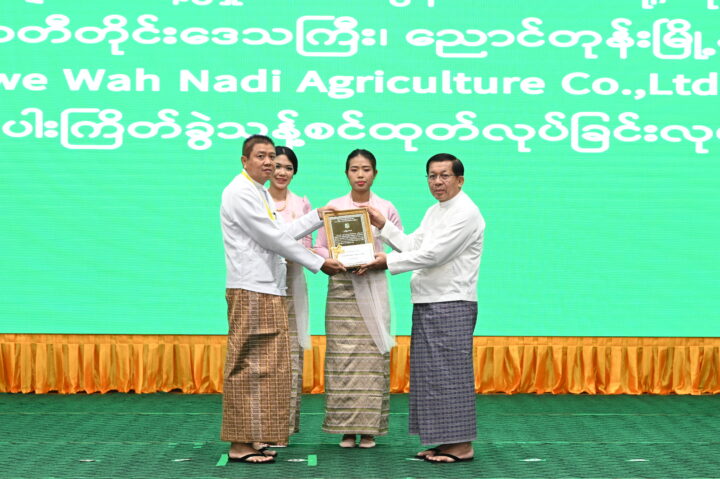
The President awarded the national-level environmentally sustainable cities prize to Hpa-an of Kayin State, the national-level environmentally sustainable villages prize to new Bawnin Village in Kalaw Township of Shan State and the good factory/workplace award to Shwe Wah Nadi Agriculture Co Ltd in Nyaungdon Township of Ayeyawady Region, respectively.
Vice-President Nan Ni Ni Aye presented first, second and third prizes to winners in the national-level clean and green school (high and middle school level); Pyithu Hluttaw Speaker U Khin Yi, first, second and third prizes to winners in the national-level clean and green school (primary level); Amyotha Hluttaw Speaker U Aung Lin Dwe, winners in the environmental commemorative university/college article contest; and Union Minister for Agriculture, Livestock and Irrigation U Min Naung, winners in the basic education high school level essay contest.
The President and party watched video clips on the messages sent by the UN Secretary-General and the UNEP Executive Director to mark the 2026 World Environment Day, and a knowledge-sharing video clip on 2026 world environmental conservation.
The President viewed the exhibitions on the 2026 World Environment Day and asked about the necessary measures regarding the presentations of officials.
Also present at the ceremony were Commander-in-Chief of Defence Services General Ye Win Oo, Union-level dignitaries, Union ministers, the Nay Pyi Taw Council Chair, senior Tatmadaw officers from the Office of the Commander-in-Chief, members of the environmental conservation committee, deputy ministers and officials.
MNA/TTA
#TheGlobalNewLightOfMyanmar