
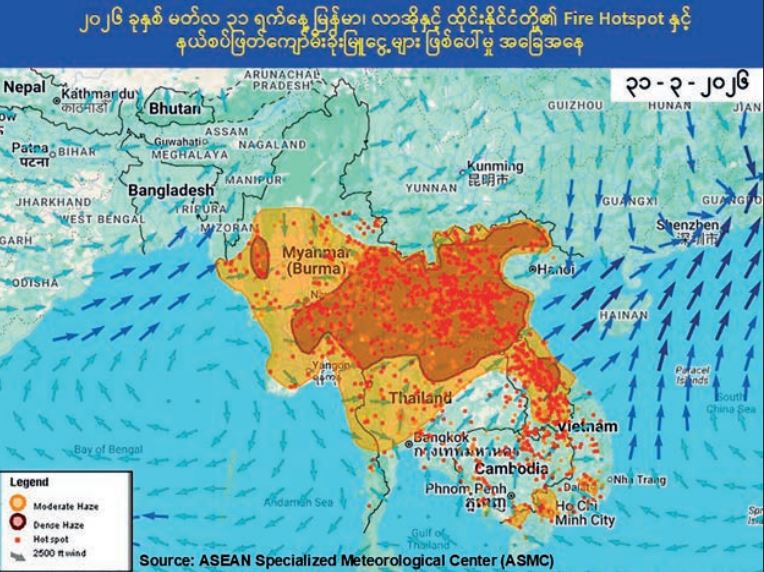
1. According to statements issued by the Singapore-based ASEAN Specialized Meteorological Centre (ASMC), regarding conditions that may lead to transboundary haze pollution-
(a) In the northern ASEAN region, including Myanmar and the Mekong sub-regions, the situation has reached Alert Level 3 for fire hotspots and smoke haze starting 27 March 2026.
(b) The dry conditions are forecast to persist over the Mekong sub-region, and the Fire Hotspot and smoke haze situation could escalate further.
(c) Based on NOAA-20 satellite surveillance, a total of 2,806 and 3,139 hotspots were detected in the sub-region on 25 and 26 March, respectively. Scattered to widespread hotspots were detected, particularly in Myanmar and the Lao PDR.
(d) Widespread moderate to dense transboundary smoke haze was observed stretching across the Mekong sub-region.
(e) In the coming weeks, the dry conditions are forecast to persist over most parts of the Mekong sub-region, with the prevailing winds expected to blow mostly from the south or southwest. Under these conditions, the hotspot and smoke haze situation could escalate further, thereby increasing the risk of severe transboundary haze occurrence in the sub-region.
2. Myanmar became a member of the ASEAN Agreement on Transboundary Haze Pollution (AATHP) in 2003. In line with this agreement, Myanmar is implementing the ASEAN Roadmap on Transboundary Haze Pollution Control (2023-2030), which aims to achieve a haze-free ASEAN by 2030, and indices have been set for reducing fire hotspots in the Mekong sub-region under the Chiang Rai Plan of Action (2017).
3. To implement the objectives and goals discussed during the trilateral meeting among the leaders of Laos, Myanmar, and Thailand on 7 April 2023, the three countries are jointly implementing a Joint Plan of Action (CLEAR Sky Strategy) to control transboundary haze pollution.
4. At the national level, Myanmar has formed committees and working groups at various levels, including the Environmental Conservation Committee and the Committee on Myanmar-Thailand Transboundary Haze Pollution Prevention, as well as regional and state-level task forces, to implement haze pollution control measures and reduce fire hotspots.
5. Starting from 2025, ground inspection teams comprising the General Administration Department, Environmental Conservation Department, and related departments have been formed, with 85 district-level teams and 220 township-level teams. These teams conduct field inspections to verify the occurrence of fire hotspots, raise awareness among local communities in affected areas, monitor hotspot conditions, measure air quality, organize educational talks, distribute pamphlets, and conduct talk shows via social media platforms.
6. To address the current transboundary haze pollution occurring along the borders of Myanmar, Thailand, and Laos, Myanmar will continue to cooperate with Thailand and Laos.
7. The people are urged to cooperate in controlling haze pollution by refraining from burning waste materials.
Committee on Myanmar-Thailand
Transboundary Haze Pollution Prevention
#TheGlobalNewLightOfMyanmar