
The Genuine Will of the People who Support Democracy
By Min Khant
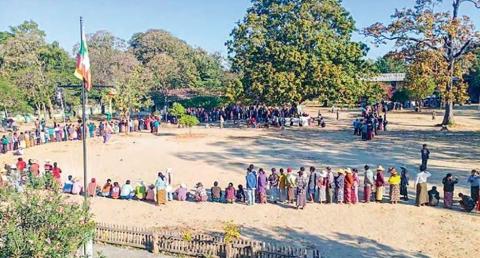
THE day of 28 December 2025 marked a very important milestone in Myanmar’s political history. In other words, it can be called a historic day on which the genuine will of the people who truly support a multiparty democracy was clearly demonstrated. From the early morning to the evening, peaceable civilians in 102 townships across the nation revealed their genuine desire through casting the ballot, which came from their hearts. With the aim of bringing about an elected government for the sake of their future, peace and stability, and better opportunities for the nation’s political, economic, and social development, they proved how they fulfilled their civic duties by taking their steps towards the polling stations where Phase I of the election was held.
The results of Phase I of the election differed from those of previous conventional elections and revealed that good outcomes were achieved to pursue the goal of multiparty democracy despite terrorist threats, disruptions, and attacks. In particular, this reflected an expression of the genuine desire of the people, who totally rejected the various forms of threats, harassment, and violent attacks carried out by those who do not wish for peace and stability in Myanmar, the political hypocrites who distort the definition of democracy, and terrorists who seek to achieve political objectives through armed struggle.
If an elected government emerges, it will become difficult for egotists who exploit political causes for personal gain to maintain their position. Likewise, armed terrorist groups operating under the guise of ethnic representation, who are attempting to seize territorial control through armed struggle, fear the emergence of Hluttaws where ethnic issues can be legitimately raised. For these reasons, they carried out criticism, slander, threats, and attacks from multiple fronts to prevent the election from taking place and to deny recognition of the election results. In response, the Government and the Election Commission acted in accordance with the law to counter such multifaceted disruptions and attacks, ensuring that eligible voters were able to cast their votes freely, safely, and without intimidation.
If we review Phase I of the election, pro-democracy citizens eagerly participated in the electoral process for establishing a democratic system. However, anti-democracy terrorists carried out various forms of attacks to disrupt and prevent the emergence of a legitimate Hluttaw in terms of politics. In other words, the difference can be witnessed between the will of pro-democracy citizens and the acts of anti-democracy terrorists. Seeing the results of Phase I of the election, it can be seen that the attempts of anti-election actions of the terrorists totally failed, as the people do not support their terrorist acts.
Phase I of the 2025 Multiparty Democratic General Election began at 6 am on 28 December. As soon as the polling stations opened, it was truly spine-tingling to see people eagerly lining up and waiting to cast their votes, especially the large number of young voters. Seeing so many young people coming to vote even drew praise from Mr Yerman Mukhtar, Vice-Chairman of the Kazakhstan Election Commission, who remarked, “I see many young people among the voters. This is a very positive sign.” He further commented, “So many young people lining up to vote shows that this country’s future is looking very bright.” This demonstrates that the nation’s youth have rejected violent paths. Instead, they proved that they want to shape their own destiny within the framework of the law.
Although some negative media outlets claimed that young voters were opposing the election, international observers vividly witnessed young voters lining up enthusiastically to cast their votes. Mr Sholban Kara-Ool, Vice-Chairman of the State Duma of the Russian Federation, also stated, “Seeing people lining up to vote clearly shows the public is genuinely engaged in choosing its future and its rightful government.”
Nicaraguan Ambassador Mr Mario Jose Armengol Campos personally observed the situation on the ground and testified, saying, “From what I have observed, the people of Myanmar are voting safely. I saw them voting freely on their own will.” The smiles and enthusiasm on the faces of the voters served to silently refute the fabricated reports circulated by negative media outlets.
Having learned lessons from the widespread reputational damage and international embarrassment caused by the NLD’s electoral fraud during the 2020 general election, the Government can be seen to have made systematic preparations this time. No matter how the anti-government media attempt to make accusations, if one listens to the genuine voices of the people who actually cast their votes, the truth becomes evident. For example, a teenage girl from Pyinmana who voted for the first time shared her feelings, saying, “I feel that I have fulfilled the civic duties, and I have raised high hopes for good leaders who will benefit young people.” These are not scripted or staged words. In fact, these reflect the sincere sentiments of citizens who voted with honest hopes for the progress of their country and their people. They did not heed malicious words spread through the air. Instead, they went to the polling stations on their own convictions.
One of the distinctive features of this election is that technological safeguards were put in place to prevent wrong voter lists and electoral fraud. Even though certain negative media have raised suspicions by suggesting the possibility of irregularities, in reality, this election utilized the Myanmar Electronic Voting Machines (MEVMs), which were domestically developed by Myanmar experts themselves. Regarding these machines, Nicaraguan Ambassador based in Vietnam, Mr Mario Jose Armengol Campos, praised the initiative, stating, “I consider the Electronic Voting Machine to be a good idea. By using this machine, voting can be done more quickly, and results can also be obtained faster.”
As clarified by the Union Election Commission, these machines operate on a standalone basis and are not connected to the internet, Wi-Fi, or Bluetooth, making external hacking or interference impossible. In addition, there are no invalid ballots. Accuracy of the voting results is assured. This constitutes a key factor in ensuring a transparent and fair election. The electoral system is no longer limited to the previous First-PastThe-Post (FPTP) system alone. Instead, it has been changed to and implemented as a Mixed-Member Proportional (MMP) system that combines proportional representation (PR). In this election, as many as 4,863 candidates from 57 political parties are running. This clearly shows that the election is oriented towards all-inclusive participation.
It can be said that the people have come to clearly grasp the essence of democracy. It is also noteworthy that the Head of State himself spoke to journalists after casting his vote. He stated, “If someone says they support a multiparty democracy, they should actively take part in elections, which are the essence of democracy. Not voting may indicate a lack of full understanding of democracy.” Those who refrain from voting after being influenced by terrorist incitement, or who boycott the vote because the party or individual they support is not participating, are just the ones with a low level of democratic awareness who do not figure out their civic duties and rights.
Some eligible voters may not participate in Phase I of the election due to low political awareness and in fear for their lives because of terrorist threats. Nevertheless, according to statements released by the Election Commission, the fact that the percentage of voters who came to vote despite intimidation and obstruction is higher than those who chose a “No Vote” clearly demonstrates the genuine will of the people who desire peace and stability.
One notable point is that the saboteurs’ “No Vote” campaigns did not produce the results they had hoped for in reality. Instead, the election concluded peacefully, highlighting the defeat of those who opposed it. The time has come for the public to carefully consider whether choosing “No Vote” truly benefits them, or whether casting a vote to support a party that can contribute to the nation’s interests, while the right to choose still exists, is the more beneficial option. Although Phase I has concluded, it is not too late. By taking the situation in Phase I as a reference, eligible voters for the remaining Phase II and Phase III of the election still have the opportunity to decide whether to participate in a “No Vote” or to cast their votes. Hence, I strongly urge responsible citizens who genuinely wish to see the country develop and progress not to be misled by political manipulation, and not to forfeit their rights, but to exercise their right to cast their votes.
Threats telling unarmed politicians, who believes in multiparty democratic path and wish to deal with political problems by political means instead of armed struggle, not to take part in the election, bombings of party offices, drone attacks on polling station areas, and attacks on towns and villages with rockets and heavy weapons on the morning of voting, all intended to frighten citizens who would come to cast their votes, are acts of terrorism. These terrorist acts are violations of human rights because such attacks attempt to disrupt and destroy the right of eligible voters to cast their ballots.
While there are organizations that criticize, attack, and oppose the electoral process, which is an unavoidable stage for the emergence of the multiparty democratic system desired by the people, and terrorists who use various means to disrupt and destroy the election, there are also nine countries that understand the essence of democracy and wish for peace and stability in Myanmar. Additionally, observers from 14 foreign embassies and 139 international election observers personally came to Myanmar to observe the election. Moreover, 215 journalists from 61 international media organizations and 1,177 journalists from 52 domestic media outlets also covered the election, which was conducted with transparency by the State. Their observation and remarks are sufficient evidence to recognize the dignified election Everybody knows that countries, including world powers, recognize Phase I of the election as a free, transparent and fair one. Mr Deng Xijun, Special Envoy for Asian Affairs of the People’s Republic of China, commented, “We have seen that the staff members carrying out their duties in the election are performing their work correctly, accurately, and well. We have observed that Phase I of the current election has proceeded smoothly and peacefully.” Similarly, Belarusian Member of Parliament Mr Shpakouski Aliaksandr stated clearly, “We believe that elections are the only correct path in a legitimate political process, and that they represent fair competition in the formation of power and the convening of parliament.” All of these are evidence that reflect the recognition of the international community on the correct path towards Myanmar’s democratic development.
Among the international community’s increasingly positive attitude towards Myanmar’s elections, indications of a shift in United States policy have also emerged as a notable development. In Real Clear Defence, a retired US Army colonel wrote that the upcoming election could become an opportunity to renegotiate and reshape US-Myanmar relations which have been stalled for decades. In addition, US Secretary of State Rubio himself has stated that he would avoid making public judgements regarding the fairness of the electoral process and democratic values. As a result, it is now becoming apparent that the United States may be shifting away from its previous approach of sanctions and towards more pragmatic cooperation based on Myanmar’s strategic importance.
Accordingly, no matter how terrorists threaten the people via social media platforms, the scenes from Phase I of the election have already proven that the people of Myanmar are firmly determined to shape their own destiny. On the morning of 28 December, the steps taken by citizens heading for polling stations were not merely simple walks. Every step they took was a historic one, clearly rejecting the path of terrorism and acts of destruction. Their historic steps demonstrated to the world their desire for peace, stability, and the rule of law.
At present, Phase I of the election was successfully held on 28 December in 102 townships. This is just the beginning. Going forward, Phase II will continue to be held on 11 January 2026, in 100 townships, and Phase III will be held on 25 January in 63 townships. The entire population believes that a new Hluttaw will be convened, a new government will be able to be formed, and national development can continue, once the whole process is completed.
Voting is not only a right of every citizen, but also a responsibility. The ink-stained little finger of each voter is a proud symbol of having contributed, a single brick and a single grain of sand, to democracy. Each ballot is a foundation stone upon which the nation’s future destiny will be built, and every step taken towards the polling station is undeniably a step towards a genuine, disciplined, and new democratic state. For these reasons, this article urges everyone not to relinquish their rights but to continue marching resolutely to the polling stations with firm and determined steps during the periods of the remaining Phases II and III of the election.
#TheGlobalNewLightOfMyanmar