
Why Myanmar can hope for a bright future after landmark electionsBy Atul Aneja
By Atul Aneja
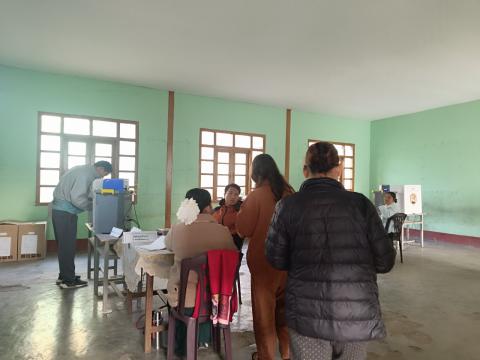
Disregarding an avalanche of criticism, Myanmar went to the polls on 28 December. The landmark elections, meant to usher in a meaningful political transition, despite violent disruptions from Non-state Armed Groups (NSAG), will last nearly a month. Two more rounds will be held – one on 11 January and another a fortnight later. These three-phased elections will set the stage for the formation of a new civilian government.
Once concluded, these polls will end the military takeover of the country, which took place in February 2021, under severely trying and exceptional circumstances.
Critics have labelled the ongoing elections as a sham, pointing out that free and fair polls are impossible due to the raging violence in many parts of the country, the military’s alleged mal-intent, and the decision by the National League of Democracy (NLD), still on paper led by Aung San Suu Kyi, who is behind bars, to boycott the polls.
Nothing could be farther than the truth. Before throwing mud at the government, these analysts have to understand that elections in Myanmar have, since its independence, always been held in troubling political contexts, and have never been perfect. This one is no exception either.
Take, for instance, the 1951 poll – Myanmar’s first founding elections. It took place at a time when the country was encountering multiple insurgencies that had immediately followed Myanmar’s independence in 1948.
The post-independence government of U Nu was labelled as the “Yangon Government”, as it was unable to extend its writ beyond Yangon, the former capital. But in a bold counteroffensive that was launched in 1950, government forces succeeded in wresting control over major urban centres. Consequently, a decision was taken to hold elections as promised in 1951.
Those landmark elections, too, were held in three phases, but lasted an extended period of over fourteen months. Starting in June 1951, they concluded in April 1952.
However, polls could not be held in many border zones, where ethnic states had been formed. In fact, polling failed to materialize in nearly 11 per cent of central Myanmar’s regions due to fighting. But, despite the odds, U Nu’s Anti-Fascist People’s Freedom League won handsomely. A decade of peaceful and prosperous democratic rule followed.
Fast forward to 2010, when another imperfect but highly consequential poll took place. In that year, the military-led State Peace and Development Council (SPDC) convened elections, following the adoption of the 2008 Constitution through a referendum.
Sceptics then too slammed those elections, which were being held after decades of military rule. National morale too was quite low, as the people en masse had been suffering from the aftermath of Nargis, a deadly super-cyclone.
Amid the pessimism, some major political parties, including the National League for Democracy (NLD), boycotted these elections. In fact, polling could not be held in the entire Wa Self-Administered Division.
But beating all odds, these elections yielded the government led by U Thein Sein, who assumed office in 2011. Despite the dim view of critics, the Thein Sein administration introduced pathbreaking 360-degree reforms, comprising political, economic and humanitarian domains. Consequently, for another decade, Myanmar plugged into the international mainstream. Foreign investments poured in, imparting forward momentum to the economy. Besides, political stability returned following the “Nationwide Ceasefire Agreement” with eight Ethnic Armed Organizations (EAOs).
Though the international context has entirely changed – the Western-dominated unipolar world hurtling towards multipolarity now – the 2025 elections do faintly echo the 2010 situation.
Several international organizations have dismissed the credibility of the polls, as the majority of the country’s remote regions are still engulfed in serious armed conflicts.
Yet, it is important to peer through the international media haze in order to evaluate the factual situation. For instance, the State Security and Peace Commission (SSPC) is all set to hold elections in 265 townships. This would cover a whopping 80 per cent of the total 330 townships in the country.
On 28 December, 102 townships went to the polls. Voters in 100 townships will head to the polling stations on 11 January, culminating in the third phase of balloting on 25 January 2026.
Contrary to the views of the poorly informed or biased external observers, who have billboarded that the elections cover less than half the population, the facts on the ground reveal otherwise. For instance, the 2024 national census shows that only 13 per cent of the total population lives in 65 townships where elections have been cancelled.
Not only are these 65 townships sparsely populated because of their remote locations, but they have also suffered heavy migration to neighbouring countries from these conflict-prone areas, further reducing the population density there.
Despite the structural difficulties, the UEC has imparted innovation and freshness to these polls.
For instance, Myanmar’s polling authorities have introduced the new Mixed-Member Proportional (MMP) system to these polls, to make them more representative. This has meant that a system of proportional representation has been introduced to Amyotha Hluttaw, or the Upper House of the parliament, as well as State and Region Hluttaws or assemblies.
Consequently, these provisions have encouraged many ethnic political parties to stand for elections, as half of the seats will be reserved for smaller parties.
In contrast, in the last three elections, the largest national parties – both the Union Solidarity and Development Party and the NLD – benefited from the First-Past-The-Post (FPTP) electoral system, as this was the only game in town.
Consequently, the smaller ethnic political parties representing Kayin, Kayah, Chin, and Pa-O groups never won a substantial number of seats, leading to significant alienation among the ethnic groups, many of whom took up arms.
Besides, the military authorities are reportedly supporting the proposed change to Section 261 of the Constitution. As a result, certain ethnic political parties will be allowed to choose their Chief Ministers, imparting a deeper connection among ethnic groups to the political process.
Taken together with the creation of larger constituencies for proportional representation, the MMP system has provided breathing space to ethnic political parties residing in conflict-prone states. This can greatly encourage the national reconciliation process.
For instance, in highly conflict-ridden regions such as Rakhine and Chin States, where elections to the Pyithu Hluttaw or the Lower House have been largely cancelled, some candidates can still hope to enter the Amyotha Hluttaw or the Upper House because of the proportional representation system. Unsurprisingly, five Rakhine political parties and three Chin political parties are contesting in the upcoming elections, despite their smaller size, taking advantage of the MMP system.
The introduction of the non-armed ethnic leaders to the legislature has another important fallout. The presence of these lawmakers can encourage a peaceful dialogue with those ethnic groups who have taken up arms. It is interesting that in these elections, nearly 18 per cent of the candidates are women the highest since polls in Myanmar began. This has raised hopes of greater participation in the peace processes of women, who have been active advocates of the cessation of conflicts and the promotion of women’s and youth rights.
Finally, the UEC has introduced Myanmar Electronic Voting Machines (MEVMs) to counter vote-counting irregularities and raise the level of transparency and accountability through the use of modern technology.
Besides, the use of voting machines erases the possibility of “invalid votes” – a major problem that was encountered when handwritten procedures were used in the past. In fact, the ratio of wasted invalid votes was as high as five per cent in all three previous elections where paper ballots were used.
The UEC has gone out of its way to ensure that the MEVMs remain tamper-proof. This has been done by ensuring that the machines are based on a simple design and have no provisions to be connected to the internet.
The success of the three-phased elections in Myanmar is not only important for spurring a process of peace and reconciliation, prosperity and cultural accomplishments, but they can also significantly encourage stability in the broader Asian region. A frontier state, bridging India and China – two major civilizational states – Myanmar is a unique country where the national interests of Beijing and New Delhi do not collide. In fact, there is a convergence of interests as both India and China can draw significant benefits from political stability in Myanmar. India’s Act East policy of greater engagement of Southeast Asia can succeed only if there is peace and security in Myanmar, a country that is a key geographic link between India and the 10-nation ASEAN. The China-Myanmar Economic Corridor (CMEC) can also only succeed if Myanmar remains conflict-free.
A forward-looking Myanmar post-election can encourage the border process of multipolarity, as Naypyidaw has shown keen interest in joining the Shanghai Cooperation Organization (SCO) and BRICS – two organizations that spearhead the international movement towards multipolarity.
(Views expressed in the article belong solely to the author.)
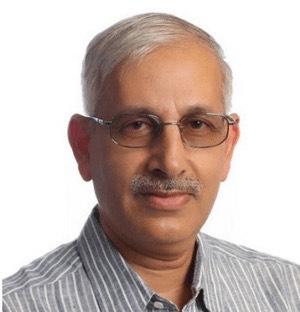
(Columnist and journalist Atul Aneja observed the Multiparty General Election held on 28 December as an international election observer, accompanying the election observation delegation from India. He is also an Adviser to the Myanmar Narrative Think Tank.)
Original Article Link-
https://www.geopolitika.ru/en/article/why-myanmar-can-hope-bright-future-after-landmark-elections?
utm_referrer=https%3A%2F%2Fwww.geopolitika.ru%2Fen%2Farticle%2Fwhy-myanmar-can-hope-bright-future-after-landmark-elections
#TheGlobalNewLightOfMyanmar