
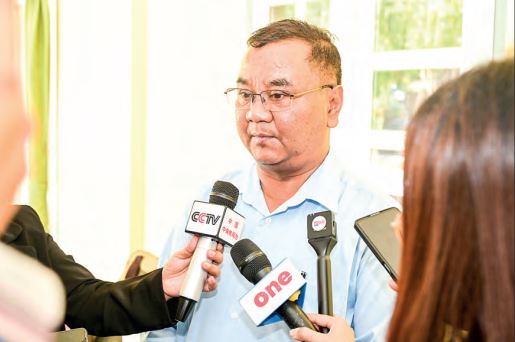
Q: It is understood that over 52 per cent of the population cast their votes during Phase I of the election. I would like to know what kind of security measures were implemented to ensure the participation of the public in the voting process.
A: Primarily, during Phase I of the election, we saw the public coming out to vote. Watching the citizens cast their ballots was truly encouraging. As I have said before, this is not the government’s victory; it is the people’s victory. It is a victory for the citizens who desire democracy and peace. Now, in Phase II, we are seeing the same thing. We can observe it together. Acting President Senior General Min Aung Hlaing, who is currently in Yangon, personally visited the polling stations today. During his visit, you would have seen people voting very actively. For instance, the Senior General himself met with the public and asked them questions. You would have witnessed him personally inquiring with voters about the voting machines—asking if the paper slip produced matched the button they pressed. The answer was ‘yes,’ which demonstrates the transparency of the process. Furthermore, some people woke up as early as 4 am to cast their votes. Once the voter lists are finalized this evening for Phase II, the results will emerge. I believe it will be a success, just as I believe Phase III will be a success. Looking back at history, when the Parliamentary Democracy election was held in 1952, it was conducted in three phases and took about five months. Each phase lasted about seven to 10 days. Back then, out of eight million eligible voters, only 1.5 million participated, which was roughly 20 per cent. Currently, there are some discussions and even campaigns being held in our country urging people not to vote; there is opposition. However, regardless of what is said, establishing a democratic system must be achieved through the electoral process. What I want to say today is that I am grateful to all the citizens who came to vote with such interest, as well as everyone supervising the polling stations, including security personnel and volunteers, for ensuring the public could vote with peace of mind.
Q: Once the election is concluded and a multiparty democratic system emerges, to what extent do you have expectations for building international relations, including with neighbouring countries?
A: Regarding international relations, there are currently certain sanctions in place. These sanctions exist because the current administration is not an elected government. However, there are still countries we maintain relations with; we have many friendly nations. For example, our relations with neighbouring countries remain intact, and we engage with one another like true close friends. Once this election is concluded, I believe international relations will become more open and transparent as the aforementioned restrictions diminish. I also expect that more foreign investment will flow into Myanmar. Along with this, I foresee that those economic opportunities will open up significantly for all our citizens.
Q: Once the election is over, the Hluttaw will be convened, a government will be formed, and the transfer of power to the newly emerged government will take place. Around which month is this schedule expected to occur? Ordinarily, such handovers take place in April. Are you able to explain the situation regarding this?
A: The Hluttaw will be convened in March. Following that, the new government will assume its duties in April. We will proceed according to the same standard schedules as were followed in the past.
Q: It is known that political parties have submitted requests and proposals regarding advance voting to the Senior General. Regarding this matter, how will the issues be handled further?
A: This is a matter for the Commission (Union Election Commission), the Commission will handle it. Most of the discussions have indeed centred around advance voting. When advance votes are counted, all candidates are invited to observe. You have seen this for yourselves. As far as I know, some representatives do not show up, yet they voice complaints despite their absence. For example, take Mayangon Township, which was completed during Phase I. You likely heard about it – the independent candidate, Dr Khin Khin Kyawt. Her conduct was quite respectable. Although she lost, she went to observe the counting of advance votes herself. Upon seeing it, she noted how transparent the process was. We cannot do these things in secret; they must be done transparently. However, I have noticed some shortcomings. The issue is that when candidates are invited to the vote counting, some fail to attend. They don’t show up, but they continue to make criticisms. I am stating this based on what I have personally witnessed; I am not speaking from a one-sided perspective. That said, there might be actual flaws. If there are, they can be clarified with the Commission. You can speak with the Commission. They will handle everything with full transparency.
Q: What is the international perspective regarding this election?
A: Regarding the international perspective, during Phase I of the election, international observation teams visited. These teams conducted thorough observations and have already shared their findings, releasing them transparently. To summarize their feedback: first, they did not expect that Myanmar would be able to conduct an election this successfully. Nor did they expect such a high voter turnout. When they went to observe, they saw people lining up at polling stations to vote, which surprised them. Secondly, regarding the voting machines, they studied them personally. They described the machines as transparent and ‘tamper-proof ’, impossible to cheat. Furthermore, they openly praised the Myanmar people’s love for democracy. For this second phase of the election, embassies based in Myanmar have sent over 100 observation representatives. Most are concentrated in major cities like Yangon and Mandalay, and elsewhere, such as Mawlamyine, Taunggyi, and Sagaing. These observation groups will share their findings when the time is appropriate. I would like to thank everyone.
#TheGlobalNewLightOfMyanmar