
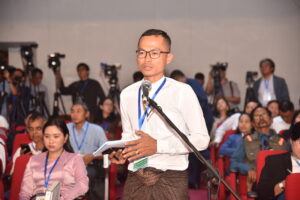
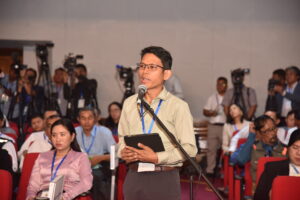


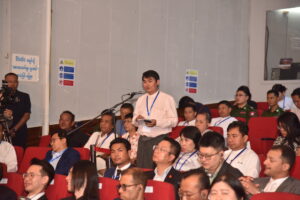

Chief Reporter U Kyaw Soe Oo from People Media Agency said that many questions had already been raised earlier. He would like to know how the State was managing and preparing measures to prevent online scam centres from spreading into major cities such as Yangon, Mandalay, and Mawlamyine. He further asked whether any arrests had been made in those locations.
Maj-Gen Zaw Min Tun explained that efforts are being made to work to ensure arrests could be made wherever necessary. He added that, during their ongoing investigations into online fraud activities in the Myawaddy area, they had received information indicating that such operations had also spread to certain locations inside the country. They had also obtained reports that some individuals were involved. He said the details would be disclosed at the appropriate time. Since the operation was still underway, releasing information at this moment would make it difficult for those conducting the investigations to pursue the cases. He said the public would be informed when the time was right.
Senior Reporter U Aung Min Thein from Eleven Media Group said online scam operations were spreading among the public in various forms. He noted that mobile-phone games were a major channel through which these scams were being carried out, mainly via mobile operators and smartphones. He asked which office people should primarily contact if they fall victim to online fraud, whether knowingly or unknowingly, and how quickly action would be taken. He added that, as mobile operators play a significant role in these activities, he wanted to know how authorities were cooperating with those operators. He further said that in connection with online scam arrests, it had been observed that foreign nationals were being transferred by Myanmar authorities back to their respective countries. He asked whether any Myanmar citizens – whether knowingly or unknowingly involved in such operations – had been arrested, and if so, what actions had been taken against them.
Police Brig-Gen Kyaw Lin explained that earlier, he had already explained the actions taken regarding online scams and the Facebook and Telegram accounts used in online games. He stated that when reviewing Facebook, Telegram and TikTok social-media accounts, many of them were opened using fake ID cards or other people’s ID cards, making it difficult to obtain accurate personal information of the account holders. He said that, to shut down the phone numbers linked to those accounts, they had to coordinate with the Ministry of Transport and Communications. Up to now, a total of 2,300 SIM cards have been deactivated. In connection with this, they had also identified and closed Pay accounts and investigated related bank accounts. So far, 149 bank accounts have been closed in coordination with the Central Bank. Regarding online scam cases, he said that if someone becomes a victim of fraud, the first step is to file a case at the police station in the area where they reside. Only after the police station concerned opens the case will the police proceed with the investigation. He said that in order to conduct investigations promptly and effectively, SOPs had already been issued for shutting down related bank accounts, blocking SIM cards, and carrying out technical verification. These procedures were designed so that relevant departments could coordinate and act within a short time frame. He added that in cases involving large sums of money or a matter requiring deeper technical investigation, the CID was assigned separately to conduct inquiries and take action. He stressed that in online scam cases, victims must file a case at the relevant local police station as quickly as possible. He stated that among those arrested in online scam operations, there were Myanmar citizens who had been working alongside foreign nationals. Whether they were knowingly or unknowingly involved – as security guards, cooks, cleaners, or in other roles – the authorities scrutinized each case and took action against those who should be held accountable, in accordance with existing laws.
News Editor U Okkar from Myanmar Hard Talk News said that regarding online scam activities, there had also been cases where the demolition of buildings used for such operations was publicized so that the international community and the world could see it. He added that propagandist media were now claiming that demolishing those buildings amounted to destroying evidence. He asked how the General would respond to such allegations. He also asked for clarification on the extent to which the KNU terrorist group was deeply involved in online scam operations.
Maj-Gen Zaw Min Tun clarified that the allegation of destroying evidence was baseless, because if crimes had truly been committed across such a large area, it would be extremely difficult to conceal evidence. He said he was not suggesting the area was small, but that any ordinary citizen could understand the nature of the evidence. Even in murder cases committed secretly by individuals without eyewitnesses, evidence eventually emerges with time. He stated that his first response to the accusations made by propaganda media was that they were meaningless. Secondly, he remarked that such groups lacked even the basic level of reasoning possessed by ordinary citizens. He said those groups would always claim that the State was collapsing. He explained that the demolition of the buildings was not done secretly but openly, with full public disclosure to the world. When journalists entered the compound, they would have seen the phones, computers and documents that had been displayed as evidence. He emphasized that there was nothing to hide. The destruction of the buildings was intended to prevent future re-use and to set a standard as a government measure. He said some people had suggested that the demolished buildings could still be put to good use, but he disagreed, stating that such structures would only be exploited again. He noted that Myanmar’s armed conflicts had begun since independence and had continued for 70 years, occurring all along the border regions. He said that the path to peace involved the NCA, with international participation, and that journalists themselves had attended NCA events many times. There was no better framework than the NCA, and the international community also supported it. Even though a clear path had been created, some groups refused to follow it, and those who had agreed to it continued moving into violent territory. He added that the possibility of fully restoring long-term stability and 100 per cent rule of law in that region must also be considered, and he did not believe the area could be safely reused. Because of that lack of trust, they decided to completely clear, demolish and dismantle the sites. He said that this also served as a clear message to the world that such actions were necessary, and that they wished to show, openly and unambiguously, which groups were operating in such a manner. For these reasons, he explained, they had taken the actions they did.
U Okka continued his question regarding the involvement of the KNU. He asked for an explanation of the extent to which the group was involved.
Maj-Gen Zaw Min Tun clarified that they had already shown video files related to the KNU, as well as documents bearing the KNU’s signatures. He said they had presented evidence demonstrating the group’s involvement. He explained how the KNU had made problems along the Thai-Myanmar border, noting that although they claimed Myanmar’s heavy weapon shells had landed inside Thailand, there had been cases where they themselves fired into Thai territory. This, too, had been shown. He urged the journalists to consider these points. He said the KNU was present throughout various parts of the border region, with some of their bases visibly erected and other areas under their influence. In these areas, online gambling activities could not operate without paying them, he said. Even in locations near Myawady—where the police were able to enforce some degree of law and order—payments to the group were still required. He stated that in territories dominated by the KNU, even Kayin nationals running online gambling operations had to pay the group to continue operating. He suggested that journalists ask local Kayin businesspeople in Kayin State directly for confirmation. Because these activities required regular payments to the group, he said the KNU couldn’t claim ignorance of the illegal operations occurring in those areas.
Daw Mi Mi Nwe from the CCTV news agency said that she had observed that Myanmar was currently taking action against online gambling and online scam operations. She asked what further plans would be implemented and what results could be expected from these continued efforts.”
Maj-Gen Zaw Min Tun stated that the first country Myanmar collaborated with on online scam and online gambling suppression was China. He emphasized that the efforts by China and Myanmar represented the most active and effective measures so far. Because of the strong cooperation, Myanmar values and appreciates China’s support and will continue to work closely with them. Secondly, he said that at today’s press briefing, they had already explained the policies and methods currently being implemented. He added that actions undertaken solely by Myanmar would continue, and for activities requiring international cooperation, they would proceed clearly and decisively according to policy. He said that, as a result, the outcomes of efforts to suppress online gambling and telecom fraud would not only benefit the people of Myanmar but also neighbouring countries, regional nations, and the international community, ensuring widespread satisfaction with the progress achieved.
Daw Ei Mon Kyaw from Xinhua News Agency asked how Myanmar plans to further enhance the effectiveness of measures against cross-border online scams operating within the country. She also asked what detailed plans the Myanmar government has implemented to ensure the safety and security of Chinese nationals within Myanmar.
Maj-Gen Zaw Min Tun said that they had already explained the detailed measures to be taken regarding cross-border telecom fraud. He said that their actions would progress step by step, depending on the emerging situation, the level of international cooperation, and the outcomes of their own measures. Therefore, extensive international cooperation and collaboration with neighbouring countries are necessary, and Myanmar itself will continue to work together with these partners. Regarding the safety and security of Chinese nationals in Myanmar, he emphasized that the Myanmar government bears responsibility for ensuring the security of all foreign nationals residing in the country, not only Chinese citizens, and that the government will fulfil this responsibility. He added that, as a special case, many Chinese projects are underway in Myanmar, including both completed and pending projects, as well as projects planned for implementation in the near future. Security measures are being implemented to ensure that these projects can be carried out safely. Other countries also have projects in Myanmar, including investments from neighbouring countries, and these projects are handled similarly. The Myanmar government is implementing special security measures for these projects, and details will be disclosed at the appropriate time. He stressed that the aim is to create a situation that is secure and guaranteed, without any compromise.
Senior Reporter Ko Thant Zin Oo from BBC News said he would like to ask follow-up questions regarding the demolition of buildings in the KK Park area. He noted that demolishing the buildings, along with presenting existing evidence from computers and phones, and working in cooperation with international partners, would produce better results. He added that a spokesperson from the National Defence and Security Council had claimed that the special US task force on scams had a hidden agenda. He asked if there was any information to confirm this claim.
Maj-Gen Zaw Min Tun replied that since he had already spoken about the demolition, he would not repeat it, and would only comment on matters related to the United States. He explained that the so-called ‘Hidden Agenda’ he referred to could be understood by reviewing their own public statements, which mentioned that their team had visited and inspected two sites related to online scams near the Myanmar border. As a first question, he asked who from the United States had visited these sites, how they had accessed areas under the Myanmar government’s control, and with whom they had coordinated. He emphasized that there had been no cooperation between them and the Myanmar government, and asked what the purpose of their plan was. He added that after forming their Task Force, they had not officially contacted the Myanmar government. He noted that, as an unusual point, some EAOs (Ethnic Armed Organizations) had also released statements about this, and that as an international news outlet, BBC reported both the Myanmar government’s and the EAOs’ statements. Some EAOs had claimed that they were working to coordinate with the Task Force sent by the United States, which was also publicly stated. He said that if there was truly a hidden element behind these actions, that would explain why these behaviours and reports had emerged, and this, he said, constituted the ‘Hidden Agenda’ he referred to.
Ko Thant Zin Oo from BBC News said he would like to ask a follow-up question regarding the visit of the Chinese Assistant Minister and his delegation yesterday. He asked for the Myanmar government’s response to the discussion in which the Chinese Assistant Minister of Public Security stated that online financial scam operations should be coordinated with regional countries and that foreign involvement in such operations would not be accepted.
Maj-Gen Zaw Min Tun further explained that the Myanmar government’s response stated that the joint Myanmar-China online scam suppression team was the first group to emerge within the international online fraud suppression framework. It added that this team is also the most practical and effective in its operations. Therefore, Myanmar will continue to cooperate closely and will not accept foreign interference in these matters. Regarding foreign interference, China, as a neighbouring country of Myanmar, shares its findings with Myanmar through diplomatic channels, and Myanmar, in turn, also shares its own findings. This approach is not limited to China-Myanmar relations but applies similarly in Myanmar’s relations with India and Thailand, as well as with Bangladesh and Laos. The government explained that instability in any neighbouring country inevitably affects other neighbouring states. Likewise, instability in Myanmar could have direct or indirect impacts on its neighbours, and instability in Thailand could also have repercussions in Myanmar. Therefore, the exchange of information between countries reflects verified facts as known to each party. Neighbouring countries also share the information they receive with Myanmar. On this basis, the Myanmar government’s stance is that information exchange must be conducted carefully and responsibly, and that such exchanges should be given priority in cooperative efforts.
Dr Zaw Than, a resident correspondent for Japan’s Sankei Shimbun newspaper, said that while the Myanmar government is actively working to completely suppress national-level online scams, the United States has formed a group called the Special Striking Force to combat online scams. It is noted that, with the same objective, the US also has collaborative activities with the Myanmar government regarding narcotics. He inquires whether the Myanmar government is willing to accept any proposal from the US Special Striking Force to cooperate with the Myanmar government in suppressing online scams.
Maj-Gen Zaw Min Tun replied that the policy of the Myanmar government is that it is ready to cooperate with any organization that seeks the welfare of our country and our people. First and foremost, the interests of our citizens, and second, the welfare of our country, must be prioritized. Otherwise, the government will act in accordance with international procedures while taking into account the sovereignty of the country.
U Kyaw Myo Min, editor-in-chief of The Statesman Journal, praised and expressed appreciation for the Maj-Gen’s recent gesture of pausing and addressing the public with a message of goodwill. He expressed his honour, happiness, and approval of the Maj-Gen’s decisive actions. Regarding the effort to completely suppress the roots of online scams, he hopes that the issue will indeed be eradicated. Currently, the online scam issue has become complicated, involving both the United States and China, with both sides approaching it from a political angle. As the online scam matter gradually transforms into a political issue, some information suggests that it could even affect the fate of the country. In this context, what kind of message should the Myanmar government convey to the public? All those involved in online scams – whether directly, indirectly, knowingly, unknowingly, or unintentionally – could have an impact. In Thailand, government authorities are involved; similarly, in Cambodia and Laos, high-level authorities are also significantly implicated. Whether knowingly or unknowingly, all parties involved in this issue could create complications for the entire country. What message should be given regarding all of them? Furthermore, EAOs (Ethnic Armed Organizations) along Myanmar’s borders have also been involved in online scams, directly, indirectly, knowingly, or unknowingly. How should the government communicate a message regarding their involvement as well?
Maj-Gen Zaw Min Tun responded that he would like to point out a situation that is not directly related to the current question. When the media reports on this matter, they tend to focus mainly on those who have been arrested, mentioning, for example, that they are Chinese nationals or Thai nationals. In this regard, it should be clarified to the media that this issue is a form of international transnational crime, carried out collaboratively by unscrupulous actors from multiple countries, known as International Organized Crime. The media should avoid assigning blame to a single nationality or country. This is an international issue, and placing blame solely on Myanmar, Thailand, or China will not resolve it. This crime requires coordinated action from all countries and organizations involved. As the correspondent mentioned, this issue has the potential to affect the fate of the country, which is true, as we have already seen in the northeastern region. There are multiple types and layers of involvement. However, the 1027 operation, which is already known to the correspondent, was launched under the banner of combating online scams. Behind this issue, there are various underlying factors, and the media are already aware of the extent to which it has unfolded. The government has repeatedly held press briefings to clarify the matter. For instance, many people fleeing from the conflict in PyinOoLwin and Mogok have arrived in Yangon, and the government has been addressing their situations. What the government wants to convey here is that if one says the international community hates online scams, it is even more accurate to say that the government strongly opposes them. Some of the affected people are civilians fleeing conflict, and their sentiments can be assessed. Therefore, the government is actively working to suppress these crimes, and there may be many parties involved, whether knowingly or unknowingly. Even in the northeastern region, there are people involved knowingly or unknowingly. Within the government bodies, as well as regional and state administrations, there are also those involved. The government has already taken measures, including major actions, to address this. Similarly, neighbouring countries have cases that require action, whether they publicize the information or not. There are even people within government organizations who are unaware that online scams are being carried out, and many activities are concealed at the surface level. Therefore, what they want to make clear is that, whether aware or unaware, they will continue to take action. They must expose the harmful elements. Whether it is due to infiltration, internal sabotage, or virus attacks, once the country is stable, we must root out these harmful elements – there is no other way. As for the EAOs, if we are to speak openly and transparently, they often cite multiple reasons such as ethnic affairs, national issues, or federal matters. In reality, however, they are primarily pursuing their own economic interests. In areas where minerals are found, they exploit the minerals; in areas with oil, they extract the oil; in forested areas, they illegally take timber. When they talk about “organizational survival”, it is worth noting how many members under their command, and the local people, are actually benefiting and prospering. To speak frankly, in Kachin State, how many union highways have been constructed by the KIA? How extensive are the railway lines? Similarly, in Kayin State, how many union highways and railways have been built by the KNU? How many homes exist to accommodate the local population? Yet, in all these areas, the EAOs are the ones enjoying and controlling these resources. Therefore, the message to the EAOs is that the NCA route already exists – it was not created by us. The EAOs themselves were the first to draft it, including within the international community. There is no reason to abandon the established NCA route due to outside pressures. By remaining on this route, they can receive the protection of the international community, the state, and the local population. Wanting to abandon it should not come as a surprise. So, the local people fully cooperate with the government. First and foremost, regarding online scams, they should not hide or feign ignorance. The government will continue to work jointly on these initiatives. The government also encourages the involved EAOs to return to the correct path and fully participate in the cooperative efforts.
Daw Khin Mo Mo Myint from NHK of Japan TV news agency reported that, regarding the election, international communities have criticized it as being conducted in a restrictive manner and lacking fairness. She requested a response concerning this point and asked for your perspective on this criticism. She also inquired whether you believe that the current election will be free and fair.
In responding, Maj-Gen Zaw Min Tun stated that such an expression in the question is very proud. Before answering the question, I would like to first ask a question myself. What does NHK mean by “international communities”? What standards are being referred to when the NHK news agency mentions these communities? Do we, in Myanmar, consider the communities referenced by NHK to be incomplete, partial, or flawed? Or do we not share that view? If we do not share that view, that assumption should be corrected first. There is no need to conduct the election in a restrictive or harsh manner. Both the journalists and the public have observed that the election is not being conducted with coercion, force, or suppression, nor is there any reason to do so. Daily information is being broadcast to ensure the public is informed about the election, and it is clear how much the public desires it. Naturally, there may be some who are not interested, and that is acknowledged, but the majority of the public supports it. Furthermore, the election is being conducted for the people of Myanmar, not for the international community. It is the government’s duty to administer it for the benefit of Myanmar. Therefore, the election is centred on the Myanmar people, and it is only important that they can cast their votes. Whether the international community is satisfied or not is irrelevant. Some partner countries provide support and assistance to ensure Myanmar’s welfare, and those who wish to criticize may do so. Our government’s goal remains to restore a multi-party democratic system and to build a union based on democracy and federalism. Whether the election is fair or not should be judged by examining all three stages: the initial conditions, the process during the election, and the situation after the election. Evaluating fairness without considering all three stages, or making claims that an election cannot be free and fair, is neither a legal nor proper assessment.
Executive Chief Editor U Moe Hein from Thuriya Naywun journal noted that there is a question of particular interest both within Myanmar and internationally. He wishes to ask about the political role and participation of Acting President of the Republic of the Union of Myanmar, Chairman of the State Security and Peace Commission and Commander-in-Chief of Defence Services Senior General Min Aung Hlaing during the election period. To be able to ask this question, the Thuriya Naywun media conducted field and online surveys over approximately three months to gauge public opinion. The results show that the majority of the public believes that, from 2021 to 2025, during the multifaceted crises faced by the nation, the leadership role of Senior General Min Aung Hlaing has been crucial in preventing the dissolution of the Union, and they are grateful for his efforts. Therefore, the question is: if, after a successful election and the formation of the parliaments, both the choices of the legislatures and the will of the people were to offer Senior General Min Aung Hlaing the position of State President, would he be seen as willing to continue serving as President? Furthermore, does Senior General Min Aung Hlaing himself wish to accept the State President position as entrusted by the people and the Hluttaw? He requested Maj-Gen Zaw Min Tun to reply to his question.
Maj-Gen Zaw Min Tun replied that since this question relates to personal matters, I will respond only to the extent of what I know and can provide evidence for. As Acting President of the Republic of the Union of Myanmar and Chairman of the State Security and Peace Commission, Senior General Min Aung Hlaing has previously made statements regarding his role dating back to around 2014, when he was Commander-in-Chief of the Defence Services. Before the 2015 election, the media had asked how he would participate politically as Commander-in-Chief of Defence Services, and he had also addressed this at that time. The Defence Services Commander-in-Chief himself has long assumed responsibilities at various levels of the State. Before he became the Commander-in-Chief of Defence Services, he served as the chairman of the Division Peace and Development Council, holding responsibilities at both the regional and national levels. Having served as Commander-in-Chief of Defence Services, he has extensive experience, and he has stated that if the state entrusts him with responsibilities, he will carry them out using that experience for the benefit of the nation. I refer to these points in my response. Regarding the selection of the President, it cannot be said personally that one “wants to become President” or “does not want to become President”. All actions must be in accordance with the law. That is, even if someone says they want to take the position, it cannot happen if it is not legally permissible. Likewise, even if someone does not want it, if they are legally elected, they cannot refuse. Experience shows that even those who initially may not want to serve have had to follow legal procedures. There are basic procedures for selecting the President. The foundational process involves the Hluttaw representatives, chosen by the people, selecting the Second Vice-President. The presidential selection process is provided in the 2008 Constitution. After the presidential electoral body is selected, votes are cast in stages, and once elected, the President assumes office in accordance with the law. In summary, I wish to emphasize that the process will be carried out in accordance with the 2008 Constitution.
#TheGlobalNewLightOfMyanmar