
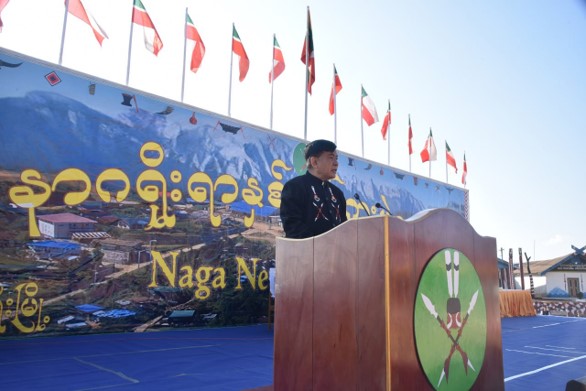

Member of the State Security and Peace Commission and Union Minister for Defence General Maung Maung Aye, together with Union Ministers U Khin Maung Yi and Dr Thet Khaing Win, Sagaing Region Chief Minister U Myat Kyaw, Lt-Gen Ni Lin Aung from the Office of the Commander-in-Chief (Army), Deputy Minister Maj-Gen Phyo Thant, regional ministers, attended the Traditional Naga New Year Festival for 2026 in Leshi yesterday morning.
Speaking on the occasion, the Union Minister said that the traditional culture, customs, and historical heritage of the Naga ethnic people are a source of pride for the nation. Their traditional attire, elaborate headgear, and customary dances all contribute to enriching the Union. The government is striving to establish a stable and peaceful country, enforce the rule of law, and advance a genuine and well-regulated multiparty democratic system. To ensure that a Union grounded in democracy flourishes, the unity of all ethnic groups, their desire for peace, and their active participation are essential keys.
During the 2025-2026 financial year, he added that the government implemented 53 projects funded by the Union budget and 208 projects funded by regional budgets to support the development of the Naga areas. In order to enable the local Naga population to engage in agriculture, livestock breeding, and other production activities for improving their socioeconomic lives, K5 billion from the State economic promotion fund was also allocated as investment. With peace and stability in the Naga areas, regional development can be implemented more effectively year by year. Therefore, maintaining peace and stability in these areas is extremely important, and the people living in the Naga regions have a responsibility to protect stability and peace.
The Union Minister emphasized that the government has built a 2,628-foot-long reinforced concrete Chindwin Bridge (Htamathi), which has improved road connectivity between Homalin and Khamti districts as well as the Naga region, accelerating the flow of goods and greatly contributing to the socioeconomic life of residents.
He continued that the government distributes high-yield, high-quality, and disease-free seeds to residents to ensure local food security and the development of the agricultural sector. Local farmers have to select and adopt cultivation methods suitable for changing seasonal conditions. To strengthen local food security, emphasis should be placed on multi-cropping in the fields to increase productivity.
In the Naga areas, he noted that it is necessary to transform the slush-and-burn system to the modern highland farmland. They need to grow konjac, tea, damson, avocado, grapefruit, and oranges as regional commercial products. Based on agriculture and livestock breeding, efforts should be made to develop small, micro, and medium-sized enterprises (MSMEs) by producing at least one speciality product per region. By processing local raw materials into higher-value products, the regional economy can be strengthened. It is also important, rather than producing a variety of small-scale goods, to focus on producing a single product in substantial quantities and with high quality.
In the education sector, he explained that policies have been effectively implemented to ensure that every school-aged child has access to basic education, to improve school retention, to enhance grade transition rates, and to reduce dropout rates before the end of the school year. These policies also aim to ensure that every citizen completes the basic education cycle (from KG+ to Grade 9). Local parents and communities have actively supported and participated in these efforts. In the health sector, the placement of doctors and nurses in local hospitals and clinics, as well as the continuous provision of medical supplies, has been consistently carried out to maintain and improve healthcare services.
Within the country, he underscored that Phase I of the 2025 general multiparty democratic elections was successfully held on 28 December 2025, and Phase II on 11 January 2026. In the Naga region, Phase I of the 2025 elections was also successfully conducted. This success highlights the need to continue implementing efforts for regional peace, stability, and development in the emerging democratic nation.
Sagaing Region Chief Minister U Myat Kyaw extended greetings while a Naga ethnic person explained the brief history on emergence of the Naga traditional New Year festival.
Patron U Hla Tun of the Naga’s traditional literature and culture central committee and Chairman of Township Committee U San Mya presented a commemorative gift to the Union Minister.
The SSPC member Union Minister for Defence, the Union ministers and officials presented aid for regional development to the Chairman of the Management and Administration Body of the Naga Self-Administered Zone, U Tun Tun Win.
The Union Minister and party cordially greeted the Naga ethnic people and posed for documentary photos. The General visited the booths of the traditional cultural exhibition.
The General and party paid homage to Aggamaha Saddhammajotikadhaja Bhaddanta Sudassana, the leader of Theravada Buddhist Missionary Monastery in Leshi and made donations. They also met Reverend U Sae Phauk of Myoma Baptist Church and donated foodstuffs.
They cordially comforted ethnic people receiving medical treatment at the Leshi People’s Hospital and gave them nutritious food. They inspected the domestic science school and youth training school in Leshi and fulfilled the needs.
In the evening, they joined the Naga traditional cultural bonfire for 2026 together with the ethnic people. The SSPC member Union Minister and the township Naga traditional literature and culture committee chair ignited the bonfire, enjoyed traditional dances of ethnic groups and presented the flower basket and cash awards to the dance troupes.
The Naga traditional New Year festival is held to preserve and safeguard the customs, traditions, and cultural heritage of the Naga people; promoting traditional Naga arts; fostering friendship, mutual understanding, and closer ties among Naga ethnic groups; encouraging Naga participation in regional development activities; and strengthening ethnic unity and promoting a sense of Union spirit based on the bonds of kinship and mutual respect among Naga communities. Local and foreign visitors come to the Naga traditional New Year festival with great interest to observe and learn, and they also happily participate together in the fire procession events. MNA/TTA
#TheGlobalNewLightOfMyanmar